Bald Eagle
Discover the incredible hunting skills, impressive recovery story, and soaring abilities of bald eagles, the proud symbol of American freedom

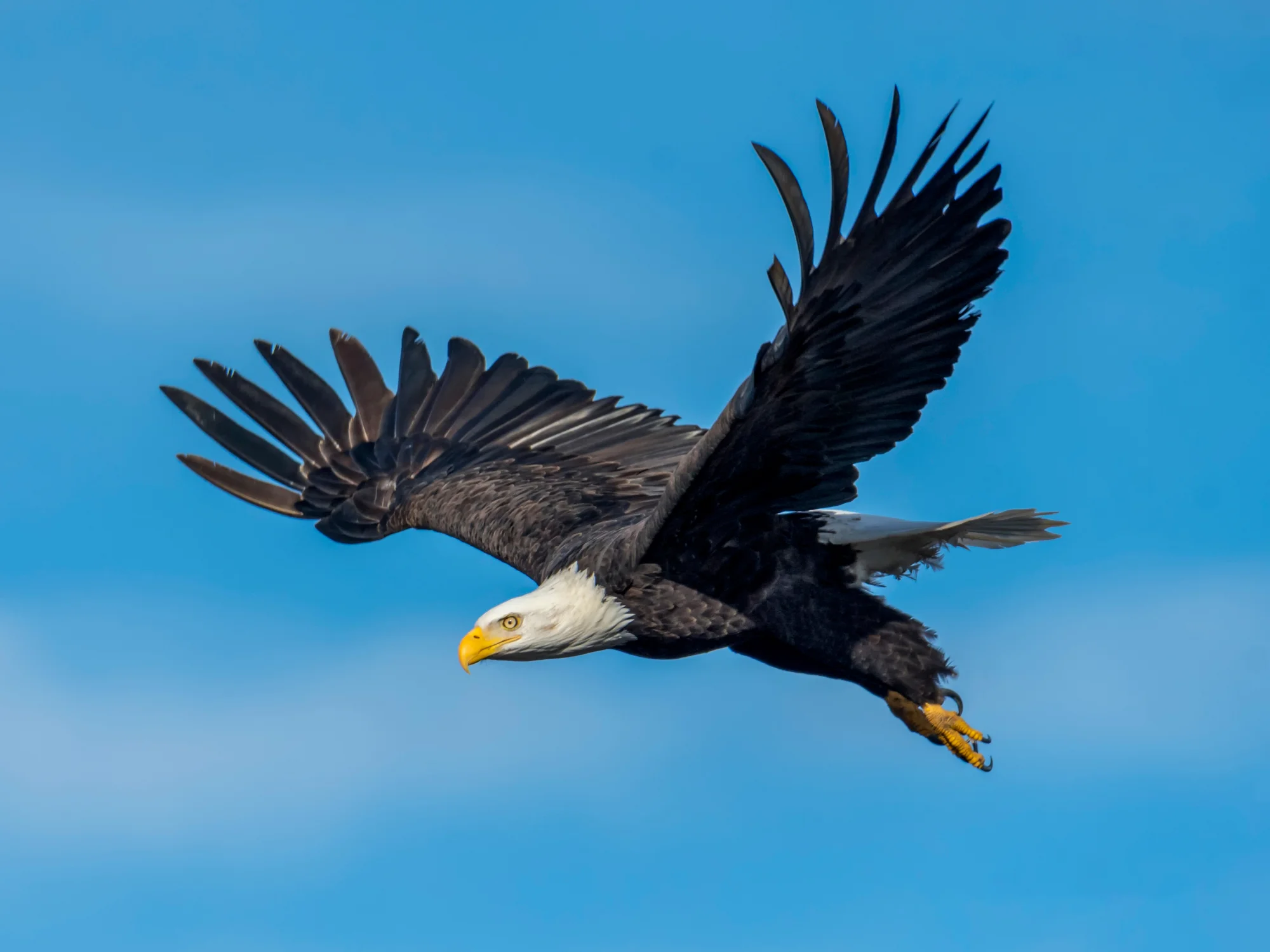
Majestic adult bald eagle with distinctive white head and tail feathers perched on a tall tree
Bald eagles are among the most magnificent and recognizable birds in North America! These powerful raptors have served as the national bird of the United States since 1782, symbolizing strength, freedom, and independence. With their impressive size, incredible eyesight, and amazing recovery from near-extinction, bald eagles represent one of conservation's greatest success stories.

Incredible Hunting Abilities
Bald eagles are superb hunters with eyesight 4-7 times sharper than humans! They can spot a fish swimming from over 2 miles away and see ultraviolet light, which helps them track prey. Their powerful talons can exert over 400 pounds of pressure per square inch - strong enough to crush bones!
While they're famous for fishing, bald eagles are opportunistic hunters that eat whatever is available. They'll catch fish, hunt waterfowl, steal food from other birds, and even scavenge carrion. Their fishing technique is spectacular - they swoop down and snatch fish right from the water's surface with perfect precision.
Amazing Flight and Size
Bald eagles are impressive fliers that can soar at altitudes of 10,000 feet and reach speeds of 100 mph in steep dives! They use thermal updrafts to gain height without flapping their wings, conserving energy while searching for food across vast territories.
Despite their name, bald eagles aren't actually bald - their distinctive white head feathers make them appear bald from a distance. Young eagles don't get their iconic white head and tail feathers until they're 4-5 years old, spending their youth with mottled brown plumage.
Where They Live
Bald eagles are found throughout North America, always near bodies of water where they can fish and find suitable nesting sites.
Specific Locations:
- Alaska: Largest population with over 30,000 eagles
- Pacific Northwest: Washington, Oregon, and British Columbia
- Great Lakes Region: Minnesota, Wisconsin, and Michigan
- Florida: Year-round residents in wetland areas
- Chesapeake Bay: Maryland and Virginia coastlines
- Colorado: Along rivers and reservoirs
- Maine: Coastal and inland lake areas
Preferred Habitats:
- Coastal areas: Ocean shores, bays, and estuaries
- Large lakes: Freshwater lakes with fish populations
- Major rivers: Wide rivers with fish and waterfowl
- Wetlands: Marshes and swamps with diverse prey
- Reservoirs: Human-made lakes near developed areas
Nesting Requirements:
- Old-growth trees: Large, sturdy trees near water
- Cliff faces: Rocky ledges in mountainous areas
- Minimal disturbance: Areas away from heavy human activity
- Good fishing: Within 2 miles of productive waters
Diet and Feeding
Bald eagles are primarily fish-eaters, with fish making up 60-90% of their diet depending on location and season:
- Salmon: Especially during spawning runs
- Trout: Both wild and stocked varieties
- Catfish: Large bottom-dwelling fish
- Waterfowl: Ducks, geese, and coots
- Small mammals: Rabbits, muskrats, and young deer
- Carrion: Dead animals, especially in winter
Eagles are also notorious for their piracy - they'll chase other birds like ospreys and force them to drop their catch, then swoop down to steal the fish!
Nesting and Family Life
Bald eagles build some of the largest nests of any bird in North America! These massive structures can be 8 feet wide, 12 feet deep, and weigh over 2 tons. Eagles often use the same nest for many years, adding new materials each breeding season.
Females lay 1-3 eggs, and both parents take turns incubating them for about 35 days. Baby eagles, called eaglets, stay in the nest for 10-12 weeks before they're ready to fly. Even after leaving the nest, young eagles depend on their parents for several more weeks while learning to hunt.
Conservation Success Story
Bald eagles faced extinction in the 1960s due to DDT pesticide poisoning, which made their eggshells so thin they broke during incubation. At their lowest point, there were only 417 breeding pairs in the lower 48 states!
Thanks to the ban on DDT, habitat protection, and dedicated conservation efforts, bald eagle populations have made a miraculous recovery. Today, there are over 70,000 bald eagles in North America - a true conservation triumph that shows how protection efforts can save endangered species.
These magnificent birds continue to inspire us as symbols of wilderness, freedom, and the power of conservation!