Bubble Art Geometry
Study surface tension while creating bubble prints and discover the mathematics hidden in soap films!
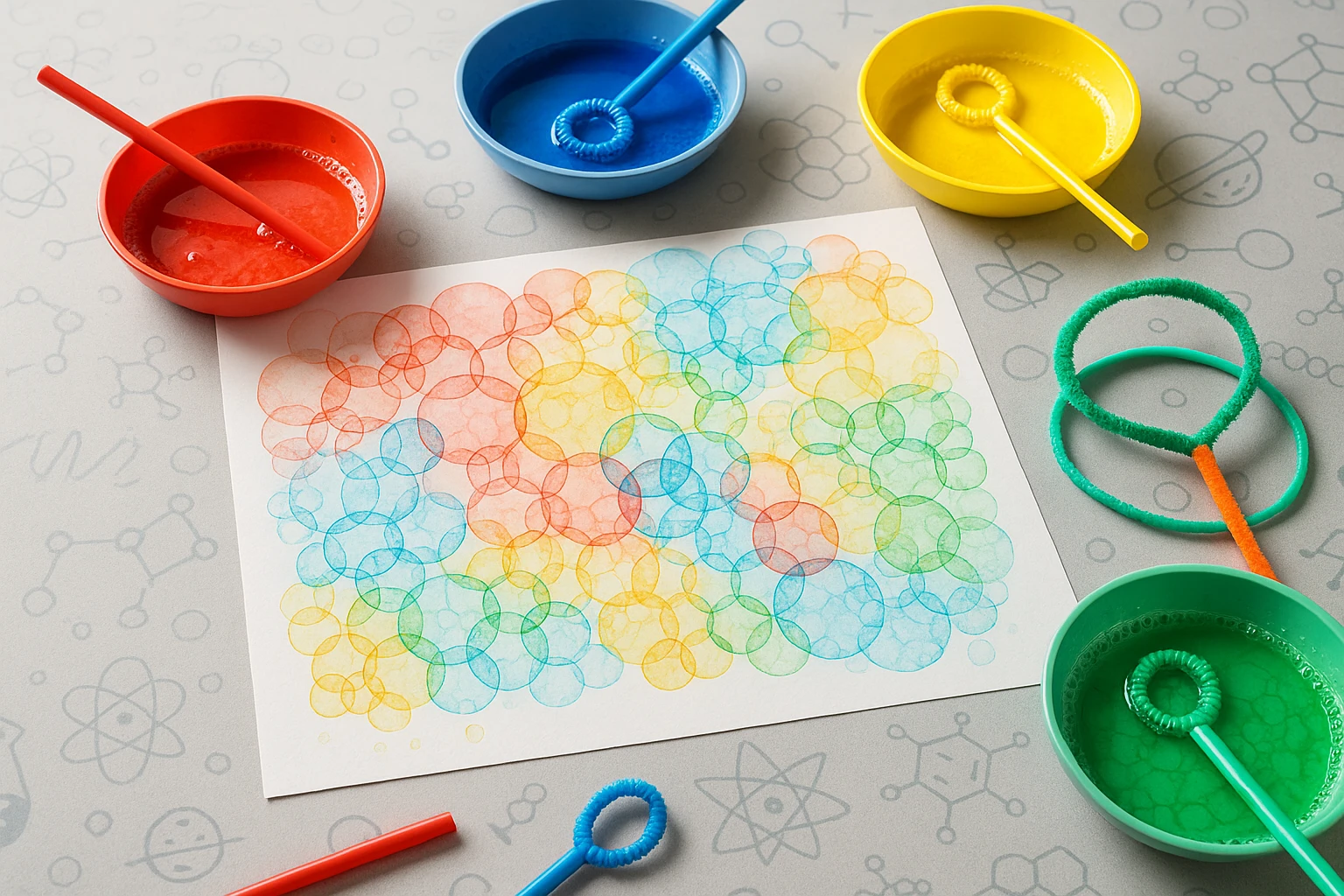
Colorful bubble prints on paper showing geometric circular patterns and overlapping designs, with bubble solution containers and various bubble-making tools arranged nearby demonstrating the artistic and mathematical aspects
EXPERIMENT PHOTO BY Duskbloom Littles
Explore the hidden mathematics of bubbles while creating stunning geometric artwork! This fascinating experiment reveals that bubbles always form perfect spheres and connect in predictable patterns because of surface tension - nature's way of using the least amount of energy possible. You'll create beautiful bubble prints while discovering the same mathematical principles that architects use to design efficient buildings!
Bubbles are mathematical marvels! Surface tension makes soap films pull themselves into shapes that have the smallest possible surface area - that's why single bubbles are always perfect spheres. When bubbles meet, they form geometric patterns with specific angles (always 120 degrees where three bubbles meet) because this arrangement uses the least energy. This is called minimal surface mathematics, and it's the same principle bees use to build hexagonal honeycomb cells!
Parent Supervision Note: This experiment benefits from adult guidance for solution preparation and cleanup management.
EXPERIMENT STEPS
What You'll Need:
- Liquid dish soap (Dawn works great)
- Water
- Food coloring or liquid watercolors
- Various bubble-making tools (straws, bubble wands, pipe cleaners)
- White paper
- Shallow dishes for colored bubble solution
- Measuring cups
- Towels for cleanup
Step-by-Step Instructions:
- Make colored bubble solutions - Mix 1 part dish soap with 2 parts water in separate containers
- Add different colors - Use food coloring to create red, blue, yellow, and green solutions
- Test bubble strength - Blow bubbles to ensure mixture creates strong, lasting bubbles
- Create bubble films - Dip bubble wands in colored solution
- Make bubble prints - Blow bubbles directly onto paper or catch them on paper surface
- Observe geometric patterns - Notice how bubbles connect and form angles
- Layer different colors - Create overlapping bubble prints for complex designs
- Study mathematical patterns - Look for repeating geometric shapes and angles
Bubble art demonstrates surface tension physics, minimal surface mathematics, and geometric principles - the same concepts used in architectural engineering, materials science, and understanding how nature creates the most efficient structures possible!