Catapult Engineering
Build your own catapult and explore projectile motion, stored energy, and engineering design!
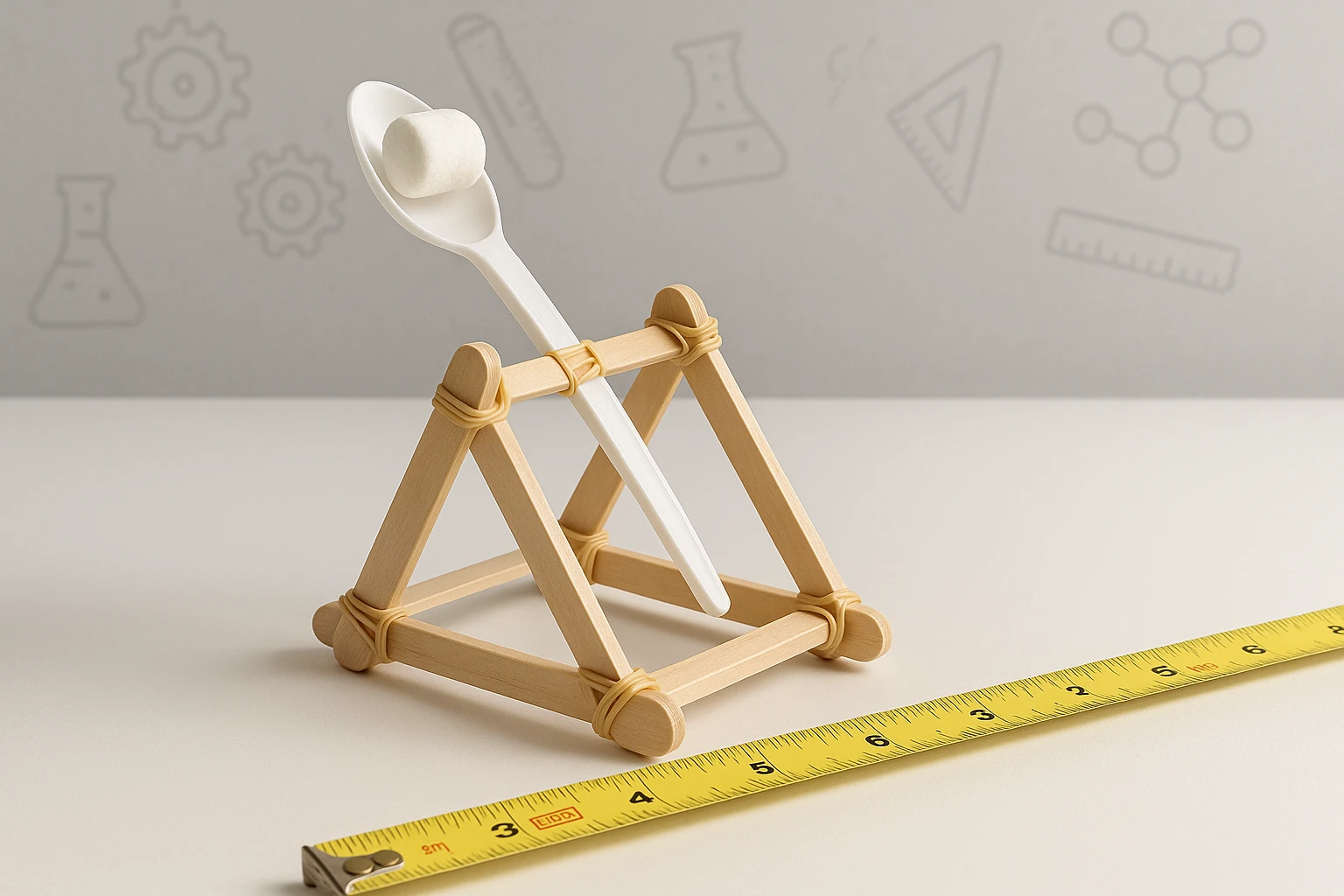
A homemade catapult built from wooden craft sticks and rubber bands, loaded with a marshmallow projectile, positioned on a table with measuring tape nearby showing the engineering design and launch setup
EXPERIMENT PHOTO BY Duskbloom Littles
Transform into a medieval engineer and build your own catapult that launches projectiles using stored energy! This exciting experiment teaches you about elastic potential energy, projectile motion, and engineering design. Your catapult works the same way as ancient siege weapons, but instead of castle walls, you'll be launching marshmallows and discovering the physics of flight!
The magic of your catapult lies in stored energy. When you pull back the launching arm, you stretch rubber bands and store energy just like pulling back a slingshot. When you release the arm, all that stored energy instantly converts to kinetic energy (motion energy), launching your projectile through the air in a curved path called a trajectory!
Parent Supervision Note: This experiment requires adult assistance with hot glue gun usage and safety oversight during testing.
EXPERIMENT STEPS
What You'll Need:
- 10 wooden craft sticks (popsicle sticks)
- 4-6 rubber bands
- 1 plastic spoon
- Hot glue gun (adult use only) or strong tape
- Marshmallows (for safe projectiles)
- Measuring tape
- Small paper cups (optional targets)
- Notebook for recording data
Step-by-Step Instructions:
- Create base - Stack 7 craft sticks and secure with rubber bands at both ends
- Make arm - Stack 2 craft sticks and wrap rubber band around one end
- Ask adult to attach spoon to free end of arm stack using hot glue
- Connect arm to base - Slide arm stack into base stack about 2 inches from end
- Add launching rubber band - Stretch band from front of base to back of arm
- Test and adjust - Pull arm back gently and ensure smooth release
- Load marshmallow in spoon and pull back arm
- Release and measure - Let go and measure how far your projectile flies!
The catapult demonstrates energy storage and conversion, projectile motion, and engineering optimization - principles used in everything from sports equipment to space missions!