Earthquakes
Learn how Earth's moving pieces create ground-shaking events that can change landscapes in seconds

Earthquake damage showing cracked roads, tilted buildings, and ground displacement
Earthquakes happen when Earth's giant puzzle pieces suddenly move! Our planet's outer layer is made of huge tectonic plates that are constantly sliding around very slowly. When these massive rock slabs get stuck and then suddenly slip, they create the ground-shaking events we call earthquakes.
How Earth Shakes
Fault lines are cracks in Earth's crust where tectonic plates meet and slide past each other. Most of the time this movement is so slow you can't feel it, but sometimes the plates get stuck together by friction. When enough pressure builds up, they suddenly snap apart, sending seismic waves rippling through the ground.
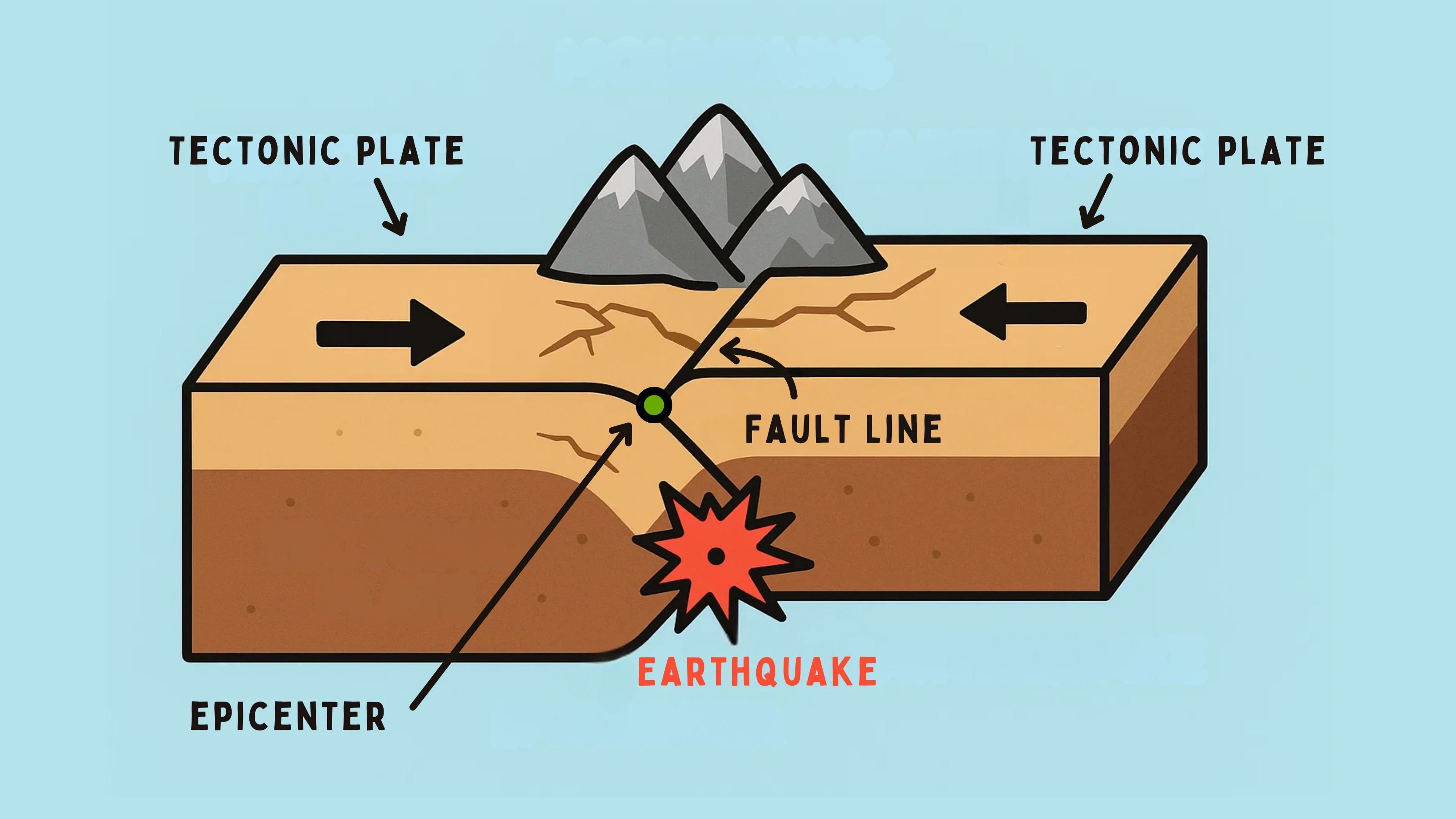 Diagram showing tectonic plates moving and creating earthquakes at fault lines
The epicenter is the spot on Earth's surface directly above where the earthquake starts underground. The focus or hypocenter is the actual underground location where the earthquake begins. P-waves arrive first and feel like a rolling motion, while S-waves arrive second and cause more violent shaking.
Earthquake Effects and Measurement
Minor earthquakes feel like a truck passing by or gentle swaying. Moderate earthquakes can rattle windows and dishes. Major earthquakes can knock people down, crack buildings, and change the landscape. The most powerful earthquakes can shift entire mountains and create new lakes.
Seismologists use special instruments called seismographs to detect and measure earthquakes. The Richter scale measures earthquake magnitude - each number represents 10 times more energy than the number below it! A magnitude 7.0 earthquake releases 1,000 times more energy than a 5.0 earthquake.
Earthquakes show us that our planet is constantly changing and moving - while they can be dangerous, understanding how they work and being prepared helps keep people safe when the ground starts to shake!