Glaciers
Explore massive rivers of ice that carve landscapes and hold most of Earth's fresh water

A glacier flows through a mountain valley, with bright blue ice and deep cracks (crevasses) showing its slow but powerful movement.
Glaciers are like Earth's giant bulldozers made of ice! These incredible formations start as snow that piles up for hundreds of years, gets compressed into solid ice, and eventually becomes so heavy that it flows downhill like a slow-motion river. Glaciers contain about 75% of the world's fresh water and have shaped many of our planet's most beautiful landscapes.
How Glaciers Form and Move
Glacier formation begins when more snow falls than melts each year. Over decades, the weight of new snow compresses lower layers into firn (granular snow), then into solid glacial ice. When the ice becomes thick enough (usually 100+ feet), gravity causes it to flow downhill at speeds of inches to feet per day.
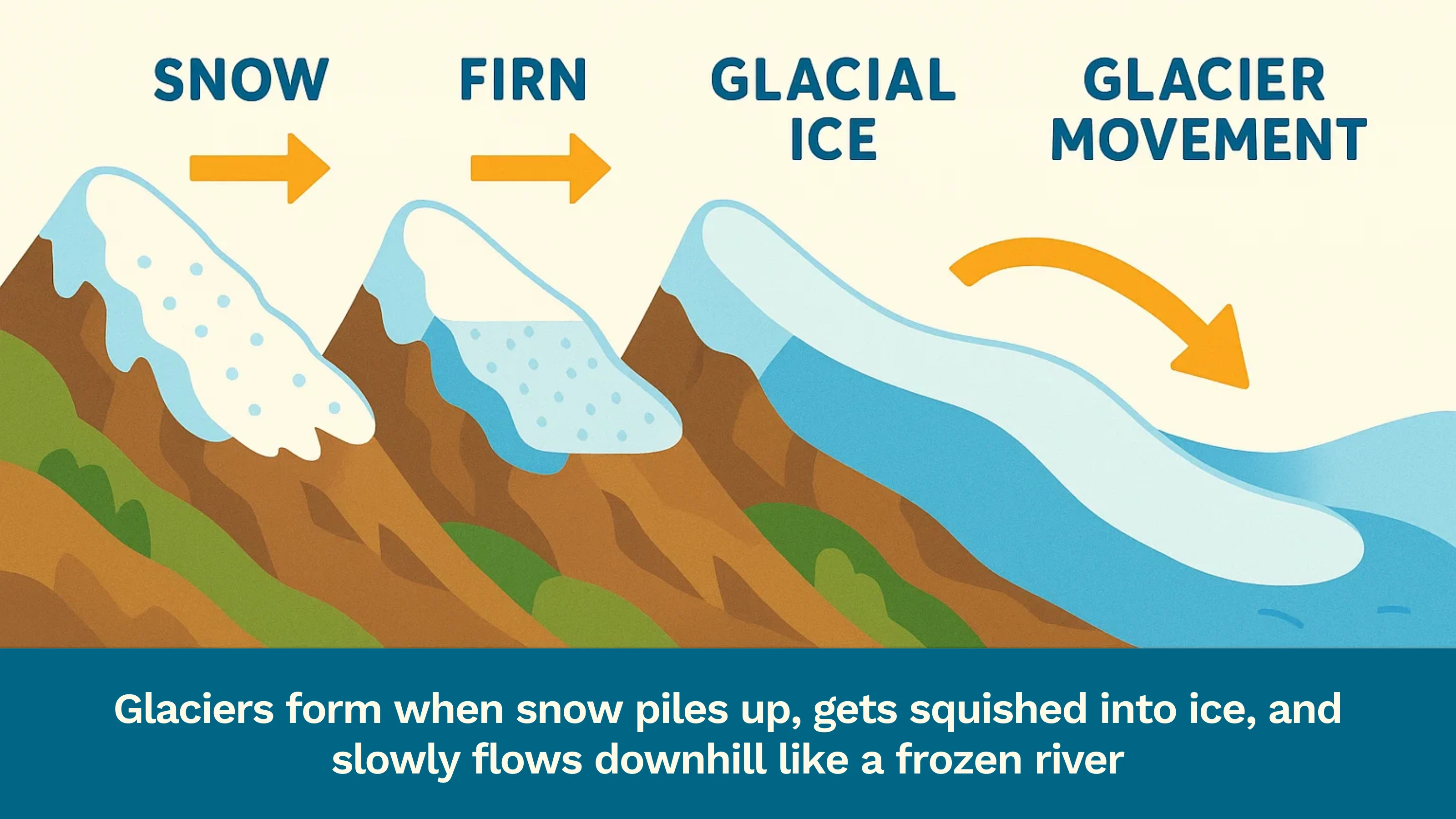 Diagram showing how glaciers form from snow accumulation and compress into flowing ice
Crevasses are deep cracks that form when glaciers bend and stretch as they flow over uneven terrain. Glacial blue ice appears blue because dense ice absorbs red light and reflects blue light. Calving occurs when glacier ice reaches the ocean and breaks off to form icebergs.
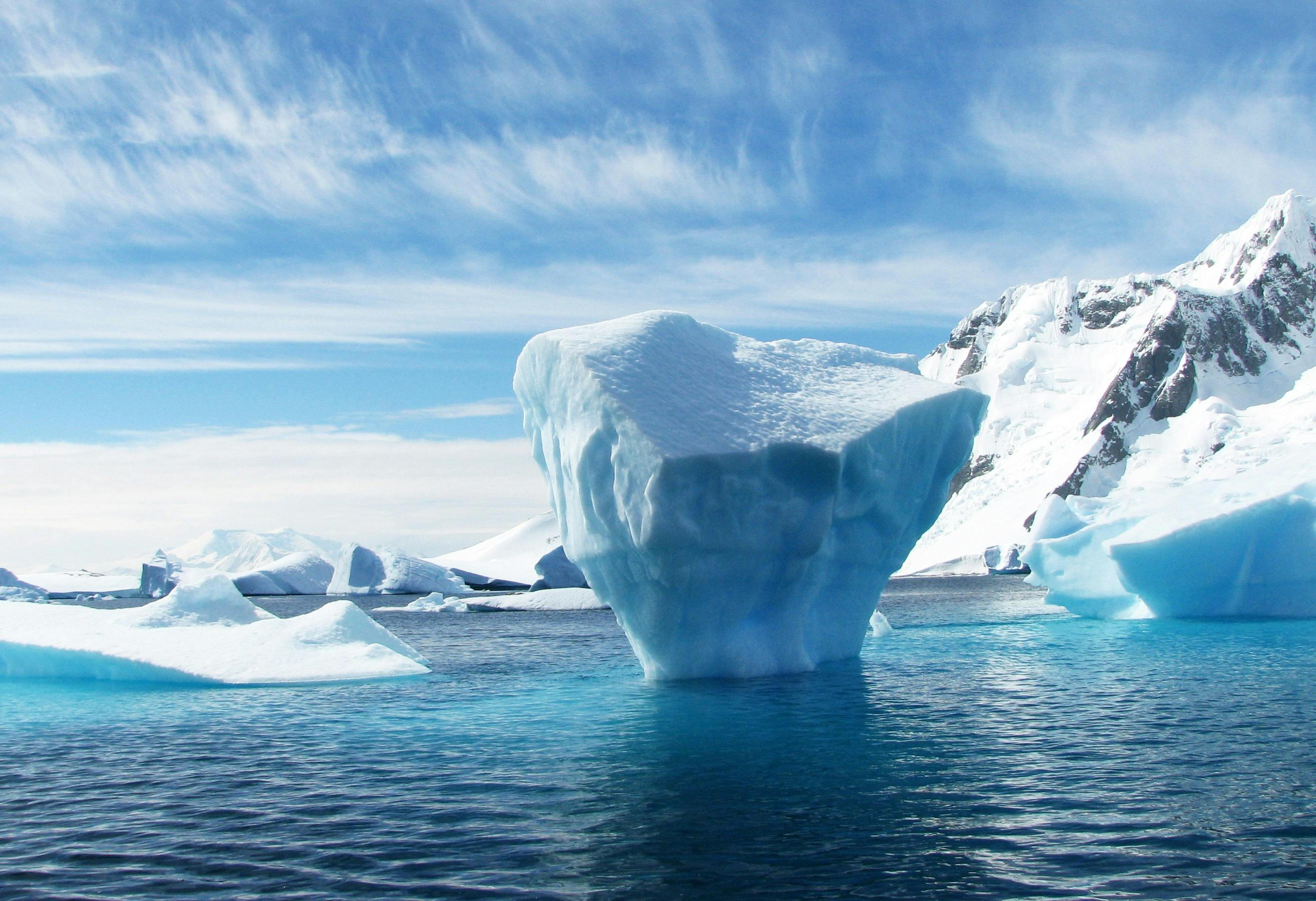
Glacial Landscape Carving
Glaciers are master sculptors that carve spectacular landscapes! U-shaped valleys are created when glaciers grind through mountain valleys, making them wider and deeper than river valleys. Fjords are drowned glacial valleys flooded by rising sea levels. Cirques are bowl-shaped basins carved at glacier starting points.
Moraines are piles of rocks and debris that glaciers push and carry along like conveyor belts. Hanging valleys form when smaller glaciers join larger ones at different levels. Glacial lakes fill depressions carved by ice, creating some of the world's most beautiful mountain lakes.
Glaciers remind us of ice ages past and help us understand how climate changes affect our planet - these massive ice rivers show us the incredible power of frozen water to carve landscapes and store precious fresh water for future generations!