Hydrothermal Vents
Explore underwater hot springs on the ocean floor where amazing creatures live without sunlight

Underwater hydrothermal vent shooting hot water with strange sea creatures living around it
PHOTOGRAPH BY Submarine Ring of Fire 2006 Exploration, NOAA Vents Program, Wikimedia Commons
Hydrothermal vents are like underwater geysers on the ocean floor! These incredible features shoot super-hot water filled with minerals from deep inside the Earth. What makes them even more amazing is that they're surrounded by some of the strangest and most wonderful creatures on our planet - animals that don't need sunlight to survive!
Underwater Hot Springs
Hydrothermal vents form when cold seawater seeps down through cracks in the ocean floor and gets heated by hot rocks near underwater volcanoes. The water gets so hot (up to 750°F!) that it shoots back up through the seafloor like an underwater fountain, carrying dissolved minerals that create colorful chimney-like structures.
Black smokers are vents that spew dark, mineral-rich water that looks like underwater smoke. White smokers release lighter-colored water with different minerals. Mineral chimneys grow around vents as the hot water cools and deposits minerals, creating underwater towers that can be several stories tall.
Amazing Vent Creatures
Giant tube worms around hydrothermal vents can grow 8 feet long and have no mouth or stomach! Instead, they have special bacteria living inside them that make food from the vent chemicals. Vent crabs are pale and blind, perfectly adapted for life in the dark depths. Pompeii worms can survive in water hot enough to kill most other animals.
Vent shrimp gather in huge swarms around the hot water, feeding on bacteria. Scale worms have special armor-like scales that protect them from the extreme conditions. Ghostly fish swim through the warm water hunting for food in this underwater oasis of life.
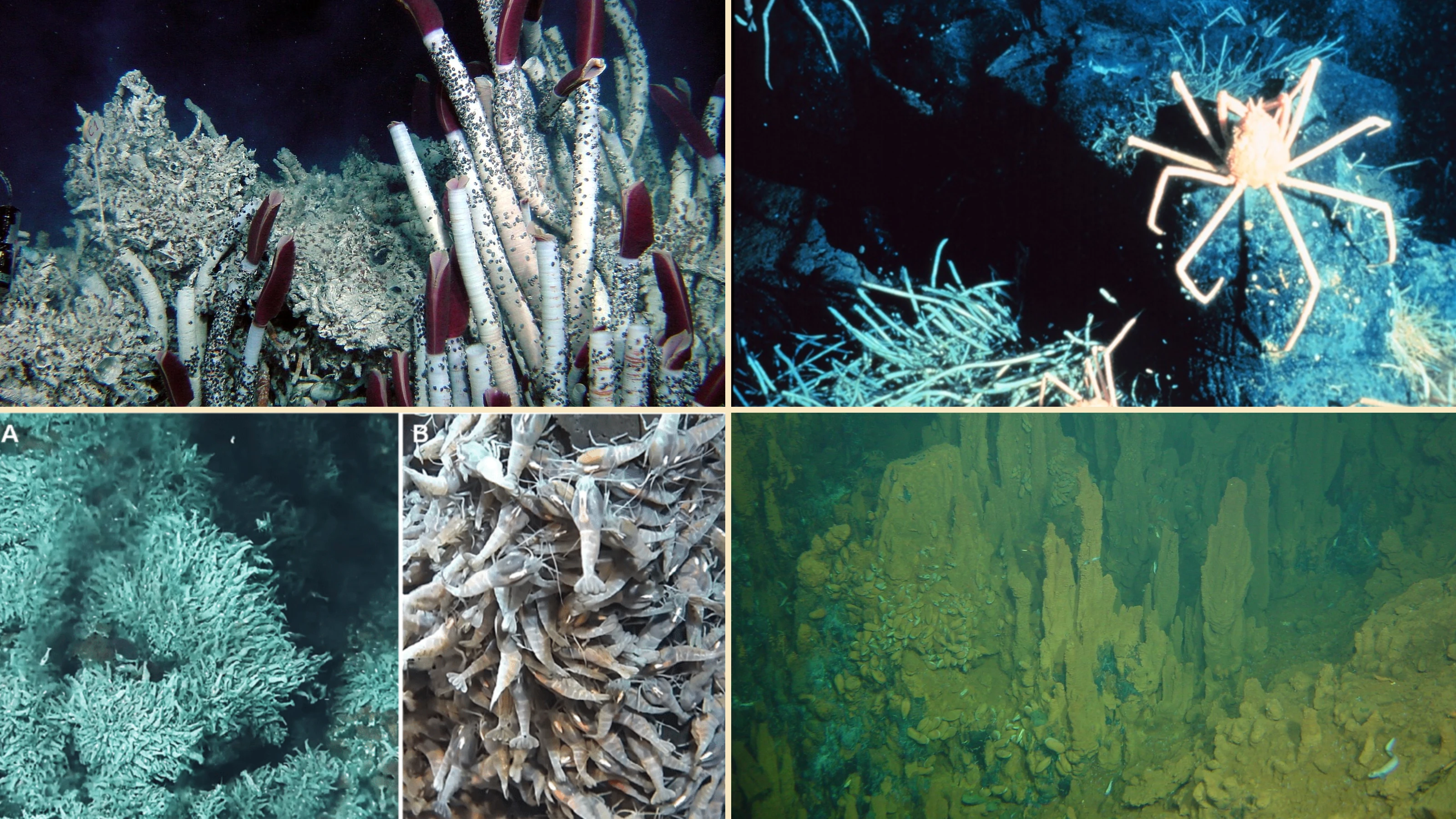 At the bottom of the ocean, near hot cracks in the Earth called hydrothermal vents, amazing animals live where it’s dark and super hot!
Top Left — These tall, red-plumed creatures have no mouth or stomach! They survive with help from special bacteria that live inside them and turn chemicals into food. [Image credit: Jozée Sarrazin and Patrick Briand, Wikimedia Commons]
Top Right — In this image Spider crabs roam the deep ocean floor at a place called the Main Endeavour Field. [Image credit: OAR/National Undersea Research Program (NURP), Wikimedia Commons]
Bottom Left — These shrimp swarm around the hot vents and eat bacteria that grow there. [Image credit: Machon, Julia & Krieger, Jakob & Meth, Rebecca & Zbinden, Magali & Ravaux, Juliette & Montagné, Nicolas & Chertemps, Thomas & Harzsch, Steffen. (2019), Wikimedia Commons]
Bottom Right — Hot underwater chimneys provide a home for shrimp, mussels, and fish that survive using bacteria instead of sunlight! Image credit: [Espèces endémiques de cheminées hydrothermales, Wikimedia Commons]
Other cool creatures like ghost fish and scale worms swim around too, turning this deep-sea vent into a hidden oasis of life!
Hydrothermal vents show us that life can thrive in the most extreme places imaginable - these underwater hot springs remind us that our planet still holds amazing secrets and that life finds ways to survive in conditions we never thought possible!