Skeletal and Muscular Systems

Discover how your bones and muscles work together to give you structure, protection, and the ability to move
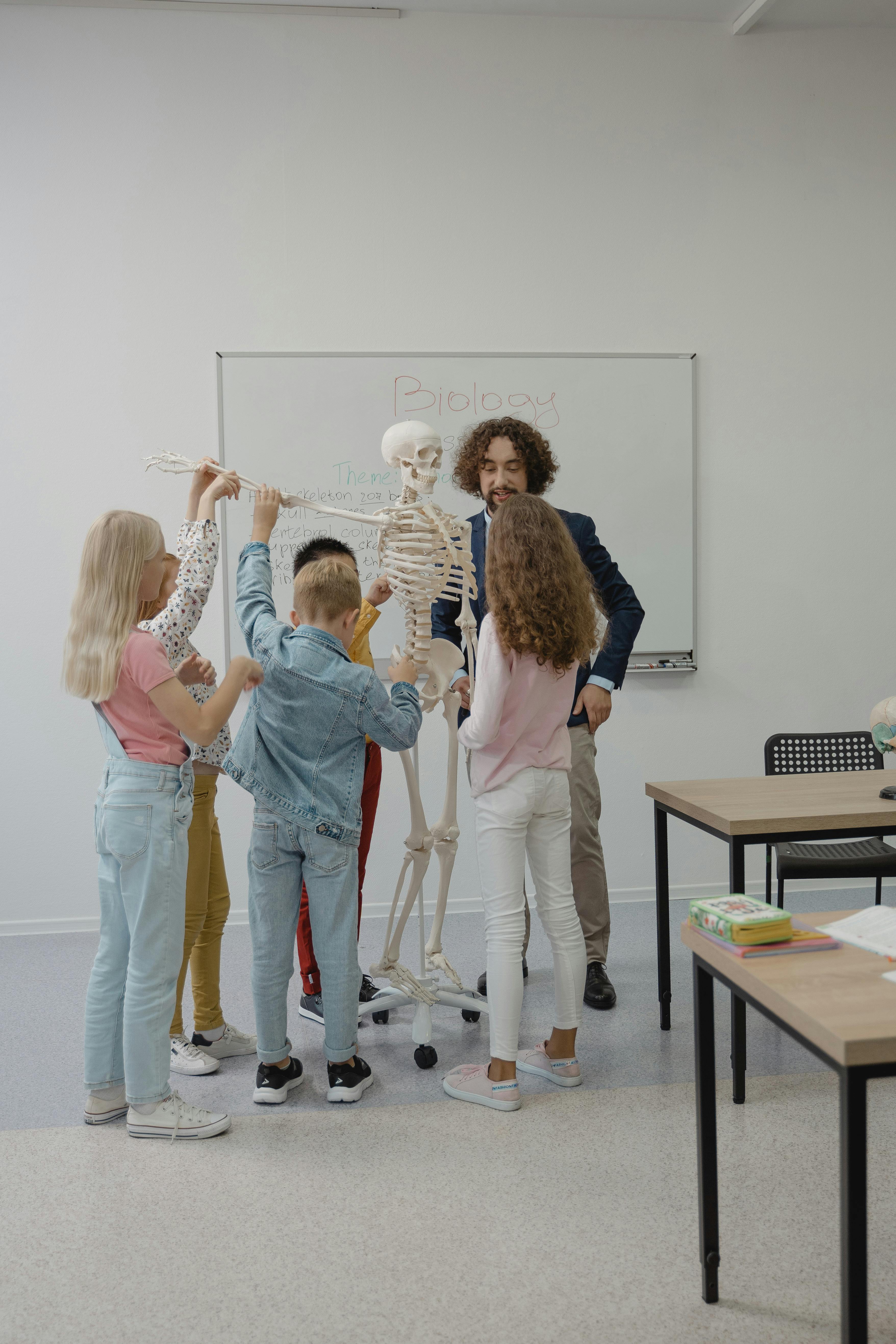

Children examining a human skeleton model and learning about bone structure
1/3

Children examining a human skeleton model and learning about bone structure

PHOTOGRAPH BY Tima Miroshnichenko, Pexels

Your body is an amazing moving machine! Your skeletal system (bones and joints) provides the framework that holds you up, while your muscular system provides the power to move. Together, they create a partnership that lets you run, jump, dance, and perform countless movements every day.

Your Skeleton: The Body's Framework

Your skeleton is made up of 206 bones (babies are born with about 270, but some fuse together as they grow). Bones aren't just hard, lifeless structures - they're living tissues that constantly repair themselves and contain blood vessels, nerves, and bone marrow that makes new blood cells!

AMAZING BONE FACTS
Bones are 5 times stronger than steel of the same weight
Your thighbone (femur) is the longest and strongest bone
Your stirrup bone in your ear is the smallest bone
Bones are about 31% water
You replace your entire skeleton every 7-10 years
Bone marrow produces 2 million red blood cells every second!

What Bones Do for You

Your bones have several important jobs: They support your body and give it shape, protect vital organs (skull protects brain, ribs protect heart and lungs), produce blood cells in bone marrow, store minerals like calcium and phosphorus, and work with muscles to create movement.

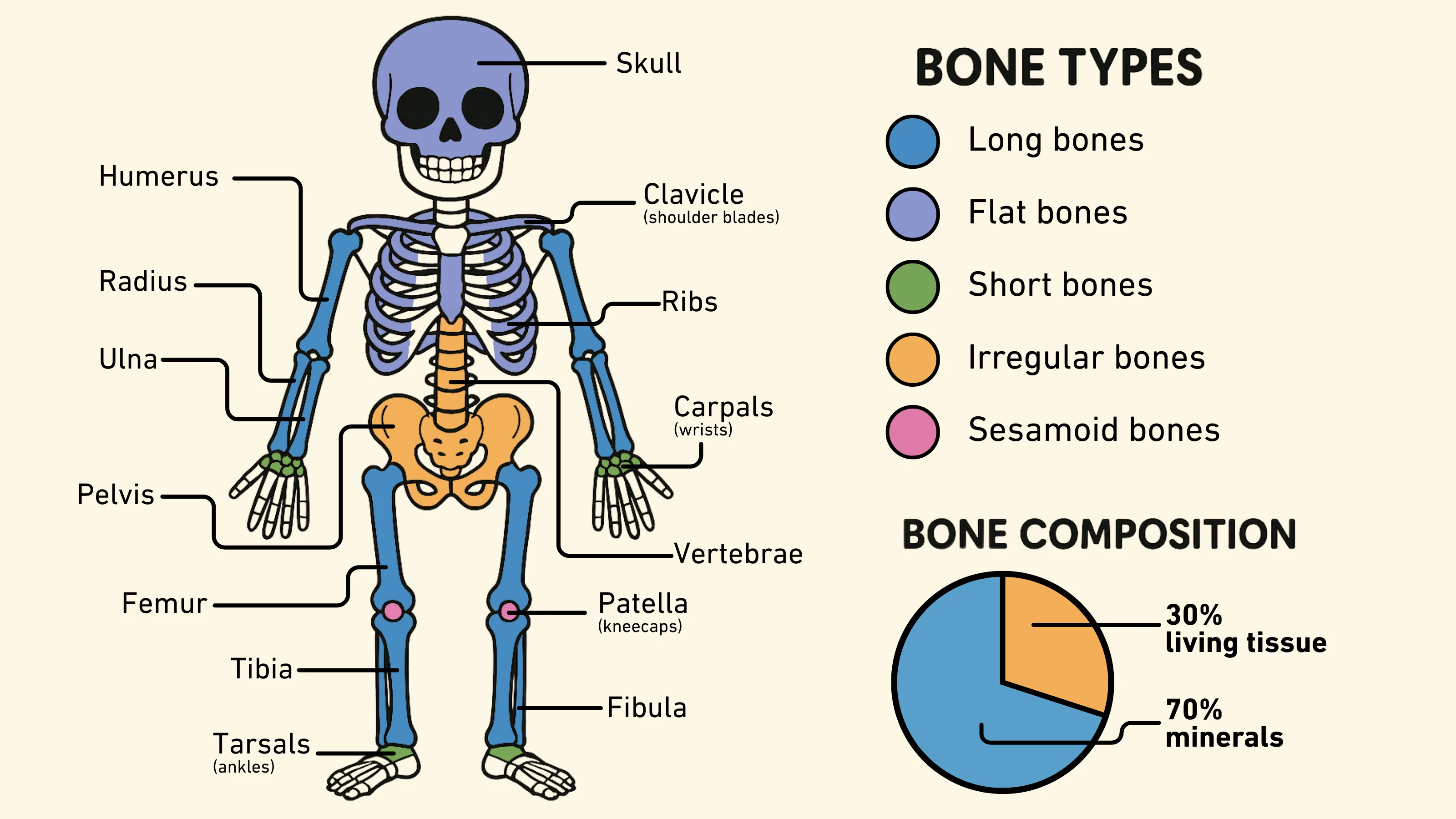
TYPES OF BONES
LONG BONES: Arm and leg bones that act as levers for movement
FLAT BONES: Skull and rib bones that protect organs
SHORT BONES: Small bones in wrists and ankles for fine movements
IRREGULAR BONES: Uniquely shaped bones like vertebrae in your spine
SESAMOID BONES: Small bones embedded in tendons, like your kneecap
BONE COMPOSITION: About 70% minerals (mainly calcium) and 30% living tissue
Info box image

Skeletal System Diagram

Muscles: Your Body's Engines

You have over 600 muscles in your body! There are three types: Skeletal muscles that you control voluntarily (like biceps), smooth muscles that work automatically (like in your stomach), and cardiac muscle that makes up your heart. Skeletal muscles work in pairs - when one contracts, its partner relaxes.

How Movement Happens

Movement requires teamwork between bones, muscles, and joints! Muscles can only pull, not push. When your bicep muscle contracts, it pulls your forearm up. To straighten your arm, your tricep muscle contracts and pulls your forearm down while your bicep relaxes.
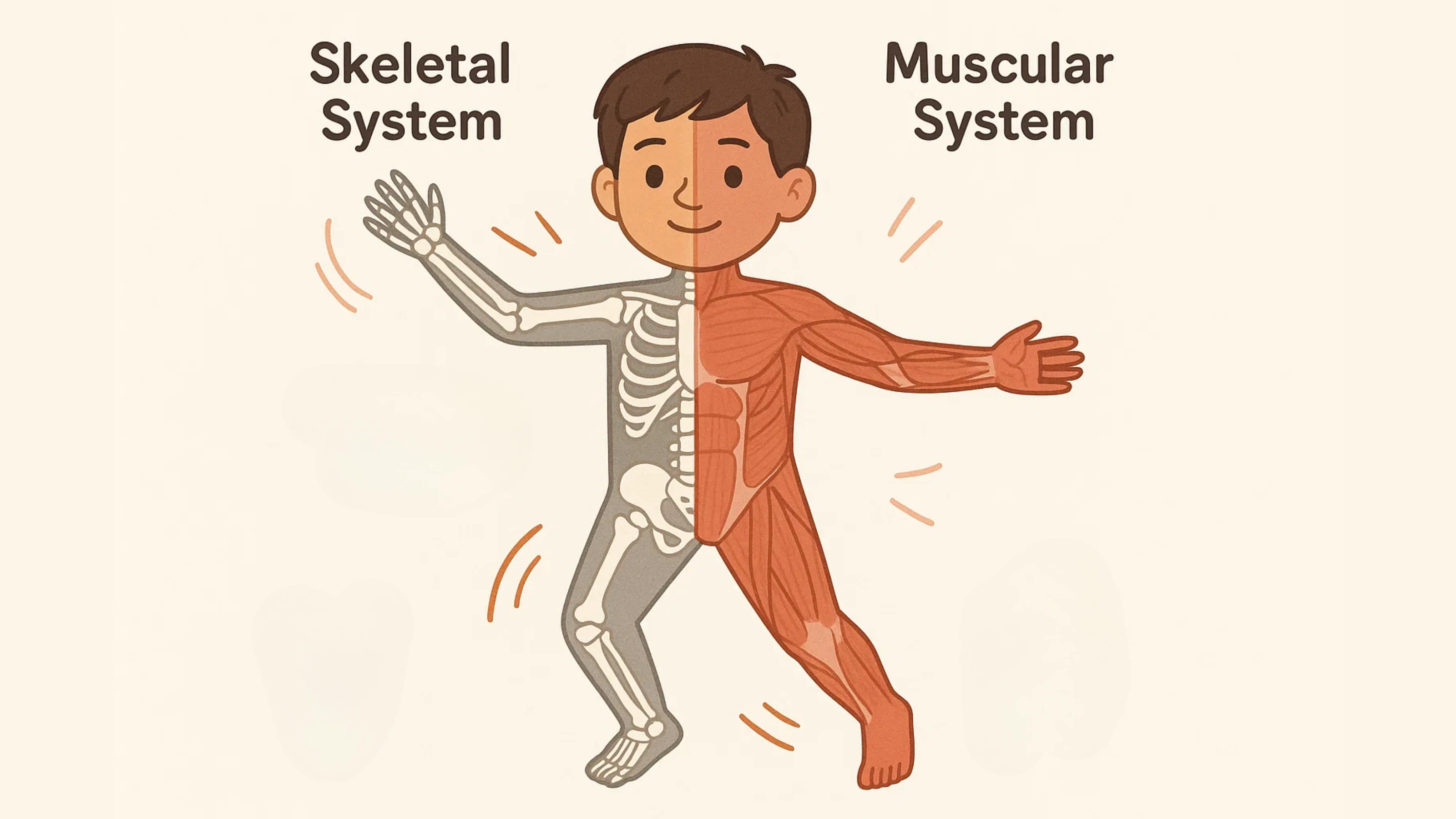
Muscular Skeletal System Diagram

MUSCULOSKELETAL ACTIVITIES
Feel how your bicep and tricep muscles work as you bend and straighten your arm
Find where you can feel bones close to your skin
Test your flexibility by seeing how far you can stretch
Try exercises that strengthen different muscle groups

KEEPING BONES AND MUSCLES HEALTHY
EXERCISE: Weight-bearing activities make bones stronger
CALCIUM: Essential mineral for strong bones (dairy, leafy greens)
VITAMIN D: Helps your body absorb calcium (sunlight, fortified foods)
PROTEIN: Needed to build and repair muscle tissue
AVOID SMOKING: Weakens bones and reduces muscle oxygen

JOINTS: WHERE BONES MEET
BALL AND SOCKET: Hip and shoulder joints that allow movement in all directions
HINGE JOINTS: Knee and elbow joints that bend in one direction
PIVOT JOINTS: Neck joints that allow rotation
CARTILAGE: Smooth tissue that cushions joints and reduces friction
SYNOVIAL FLUID: Natural lubricant that keeps joints moving smoothly

MUSCLE TYPES AND FUNCTIONS
VOLUNTARY MUSCLES: You control these consciously (walking, writing)
INVOLUNTARY MUSCLES: Work automatically (heart beating, digesting food)
FAST-TWITCH FIBERS: For quick, powerful movements (sprinting, jumping)
SLOW-TWITCH FIBERS: For endurance activities (marathon running, posture)
MUSCLE MEMORY: Practice makes movements become automatic

PROTECTING YOUR MUSCULOSKELETAL SYSTEM
Warm up before exercise to prevent muscle strain
Use proper technique when lifting heavy objects
Wear protective gear during sports to prevent bone fractures
Get enough rest for muscle recovery and bone repair
Maintain good posture to reduce stress on spine and joints

Your skeletal and muscular systems are incredible examples of biological engineering - they give you the strength to lift, the speed to run, and the precision to write, all while protecting your vital organs!