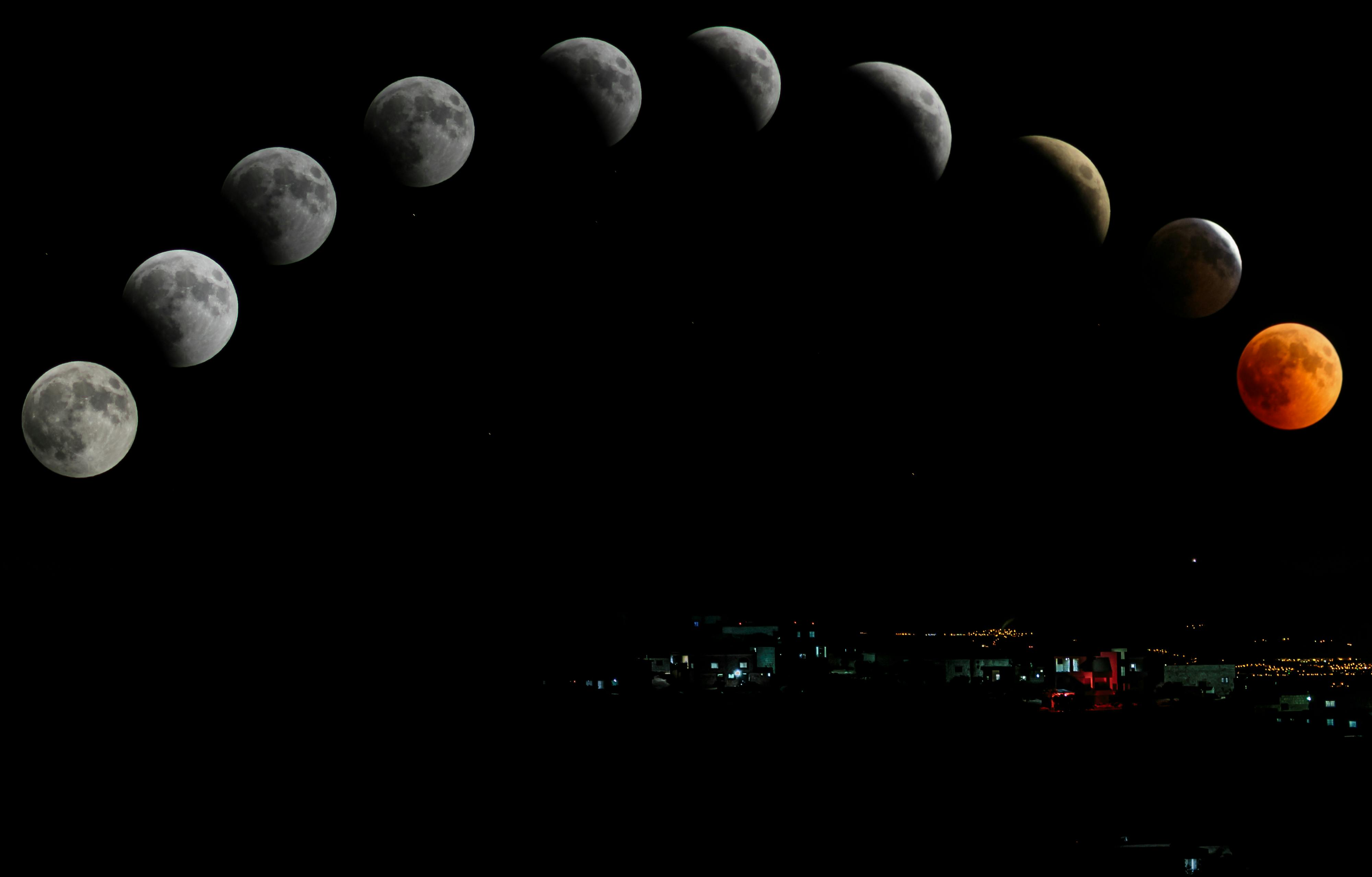
Look up at the night sky and you might see a bright full moon, a thin crescent, or no moon at all! The Moon's shape seems to change throughout the month, but it's actually always the same round ball. What changes is how much of the Moon's sunlit side we can see from Earth as it orbits around us.
Why Does the Moon Change Shape?
The Moon phases happen because the Moon orbits Earth while both Earth and Moon orbit the Sun. The Moon doesn't make its own light - it reflects sunlight like a giant mirror in space! As the Moon moves around Earth, we see different amounts of its lit-up side, creating the phases.
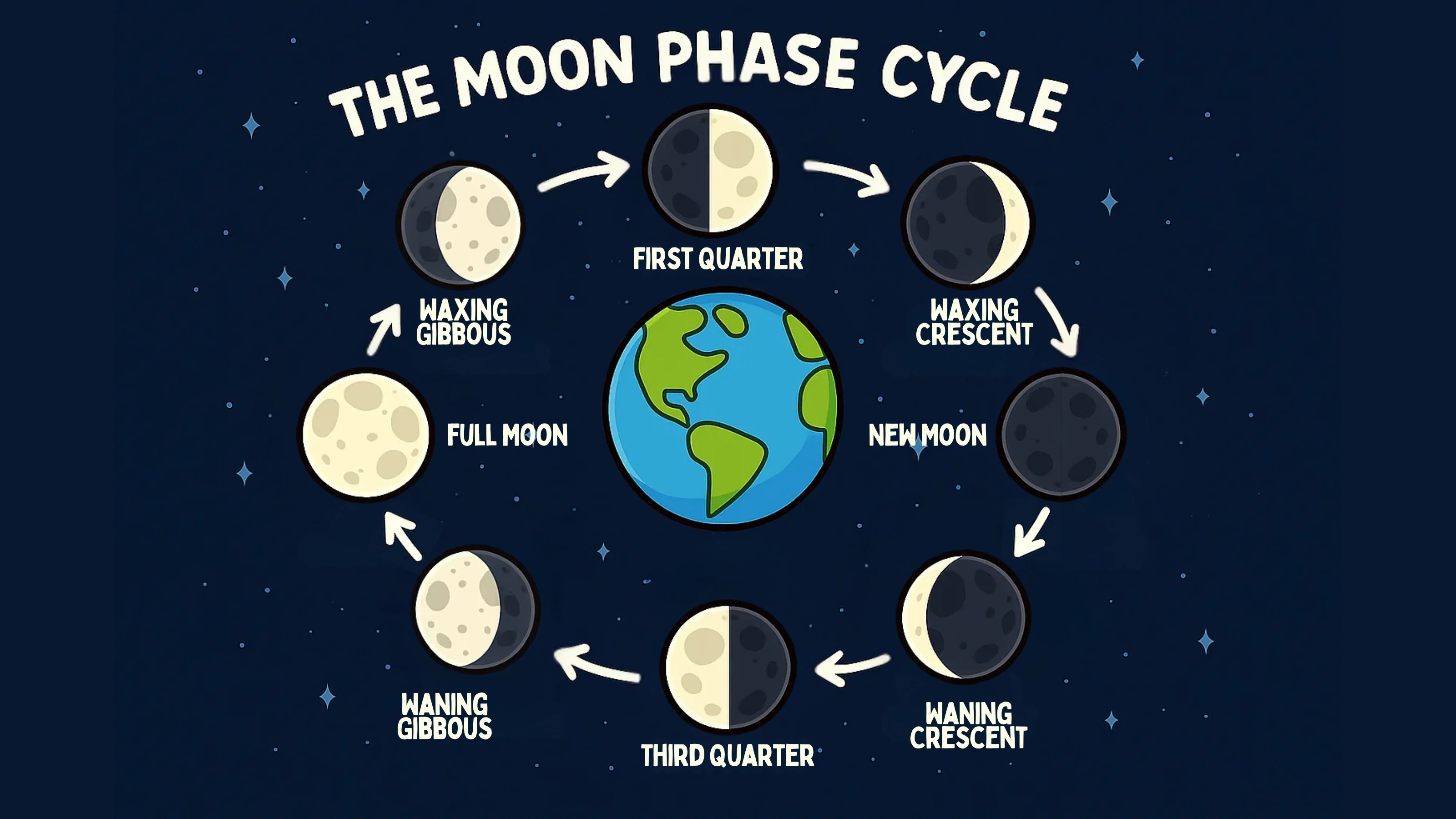
NEW MOON: Moon between Earth and Sun - we can't see the lit side
WAXING CRESCENT: Small sliver of light appears on the right side
FIRST QUARTER: Right half of Moon is lit up (looks like a half circle)
WAXING GIBBOUS: More than half lit, growing bigger each night
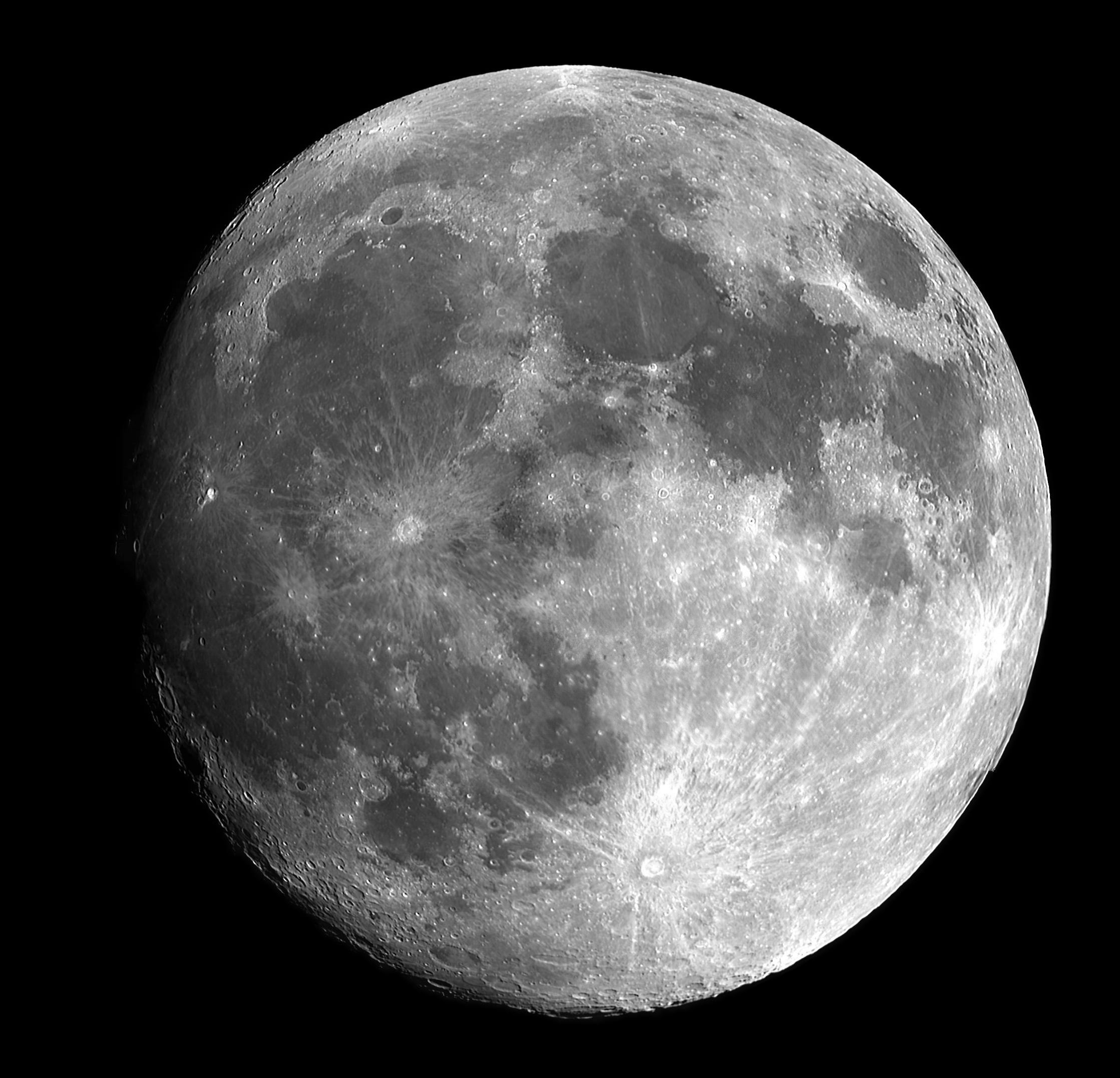
FULL MOON: Entire Moon face is lit up and visible
WANING GIBBOUS: Full Moon starts getting smaller on the right side
THIRD QUARTER: Left half of Moon is lit up
WANING CRESCENT: Small sliver on left side before returning to new moon
The Eight Phases of the Moon
The complete lunar cycle takes about 29.5 days and includes eight main phases. "Waxing" means the lit portion is growing larger, while "waning" means it's getting smaller. "Gibbous" means more than half is lit, while "crescent" means less than half is lit.
CYCLE LENGTH:
29.5 days from one new moon to the next
SAME FACE:
Moon always shows the same side to Earth (called "synchronous rotation")
TIMING:
Moon rises about 50 minutes later each day
VISIBILITY:
Different phases are visible at different times of day
BRIGHTNESS:
Full moon is about 400,000 times dimmer than the Sun
TIDAL INFLUENCE:
Moon phases affect ocean tides on Earth
The Moon and Ocean Tides
The Moon's gravity pulls on Earth's oceans, creating tides! During new moon and full moon phases, Earth, Moon, and Sun line up, creating extra-strong "spring tides" with higher highs and lower lows. During quarter moon phases, we get gentler "neap tides."
Observing Moon Phases
You can track moon phases by observing the night sky regularly! The new moon is invisible, the first quarter looks like the letter "D," the full moon is a complete circle, and the third quarter looks like a backwards "D." Each phase appears at different times and directions in the sky.
Keep a moon journal and draw what you see each night for a month
Use an Oreo cookie to model different moon phases
Track when the moon rises and sets during different phases
Notice how moon phases affect the brightness of nighttime
NEW MOON: Not visible (rises and sets with the Sun)
WAXING CRESCENT: Visible in western sky after sunset
FIRST QUARTER: Visible from noon until midnight
WAXING GIBBOUS: Visible from afternoon until early morning
FULL MOON: Visible all night long (rises at sunset, sets at sunrise)
WANING GIBBOUS: Visible from late evening until morning
THIRD QUARTER: Visible from midnight until noon
WANING CRESCENT: Visible in eastern sky before sunrise
CALENDARS: Many cultures use lunar calendars based on moon phases
FARMING: Traditional farmers planted and harvested by moon phases
FESTIVALS: Many holidays and celebrations follow lunar cycles
NAVIGATION: Sailors used moon phases to help navigate at sea
MYTHOLOGY: Moon phases inspired countless stories and legends across cultures
MODERN TIMES: Some people still follow lunar gardening and fishing calendars
APOLLO MISSIONS: Humans walked on the Moon during full moon phases for better visibility
LUNAR SAMPLES: Moon rocks brought back to Earth help us understand Moon's composition
CRATER OBSERVATION: Different moon phases reveal different crater details
SPACE STATIONS: Astronauts can observe moon phases from space
FUTURE MISSIONS: Plans for lunar bases will need to work with month-long day/night cycles
TELESCOPE VIEWING: Amateur astronomers use moon phases to plan observations
MOON PHASE CAUSES: Phases are NOT caused by Earth's shadow (that's a lunar eclipse)
WEREWOLF MYTHS: Full moons don't actually affect human behavior
PLANTING BY PHASES: Scientific evidence doesn't support lunar gardening claims
MOON SIZE ILLUSION: Moon looks bigger near horizon due to optical illusion, not distance
BLUE MOON: Refers to second full moon in a month, not actual color
DARK SIDE: There's no permanently dark side - all sides get sunlight during lunar orbit
The Moon phases connect us to the cosmic dance of Earth, Moon, and Sun - watching these changes reminds us that we're part of a solar system in constant, predictable motion!