Rock Cycle and Minerals

Discover the three types of rocks and learn how they transform through the endless rock cycle


Children examining different types of rocks and minerals in a river
1/3

Children examining different types of rocks and minerals in a river

PHOTOGRAPH BY Kelly Sikkema, Unsplash

Every rock tells a story that's millions of years old! The rock cycle is Earth's amazing recycling system that constantly transforms rocks from one type to another. Understanding rocks and minerals helps us read the incredible history written in stone all around us.

What Are Minerals?

Minerals are the building blocks of rocks - they're naturally occurring, solid substances with specific chemical compositions and crystal structures. Think of minerals like ingredients in a recipe, and rocks like the finished dish made from combining different minerals together.

MINERAL CHARACTERISTICS
NATURALLY OCCURRING: Formed by natural Earth processes, not made by humans
SOLID: Have definite shape and volume (not liquid or gas)
INORGANIC: Not made from living things (though some can form from fossils)
DEFINITE COMPOSITION: Specific chemical formula
CRYSTAL STRUCTURE: Atoms arranged in repeating patterns

The Three Types of Rocks

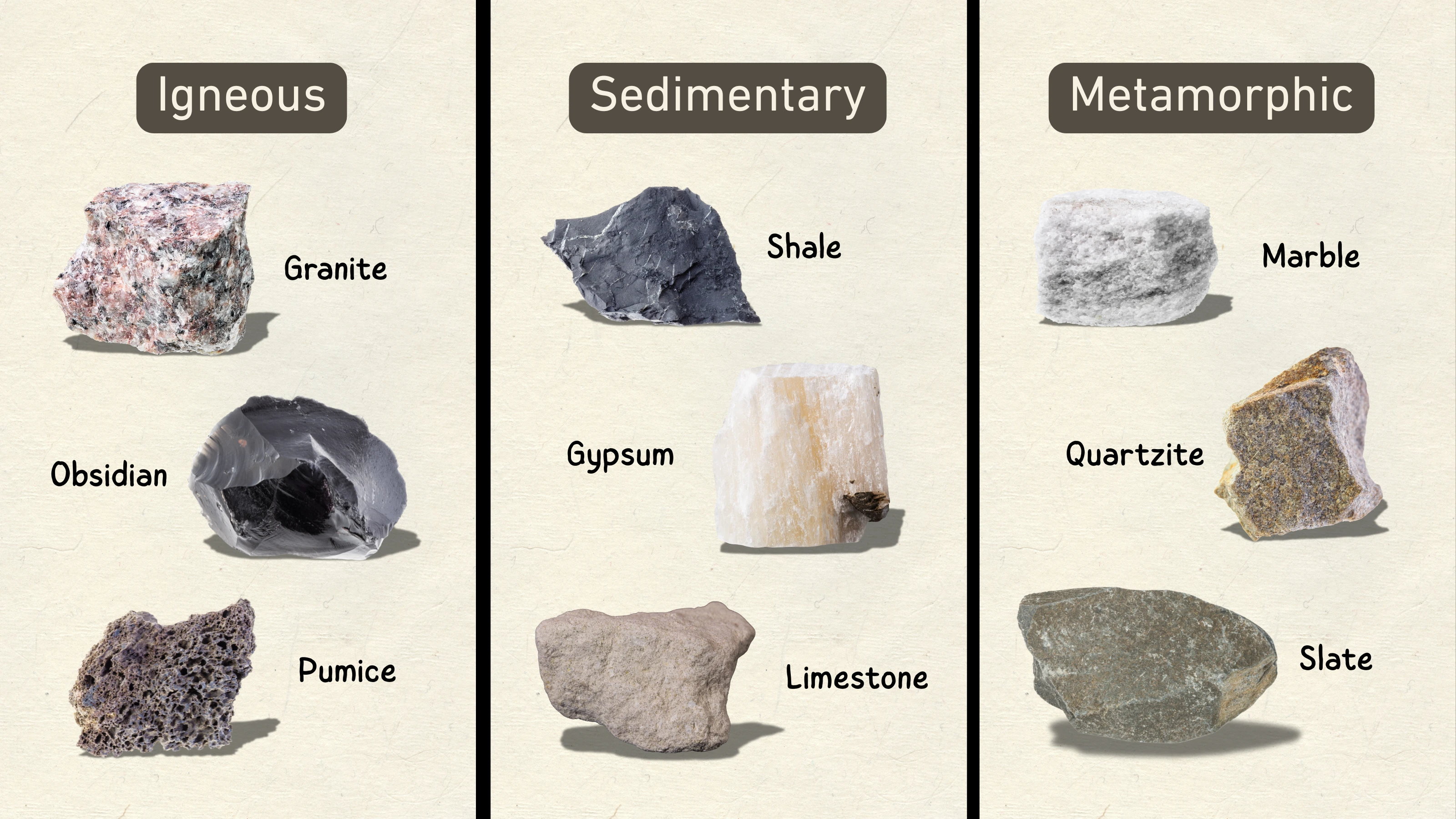
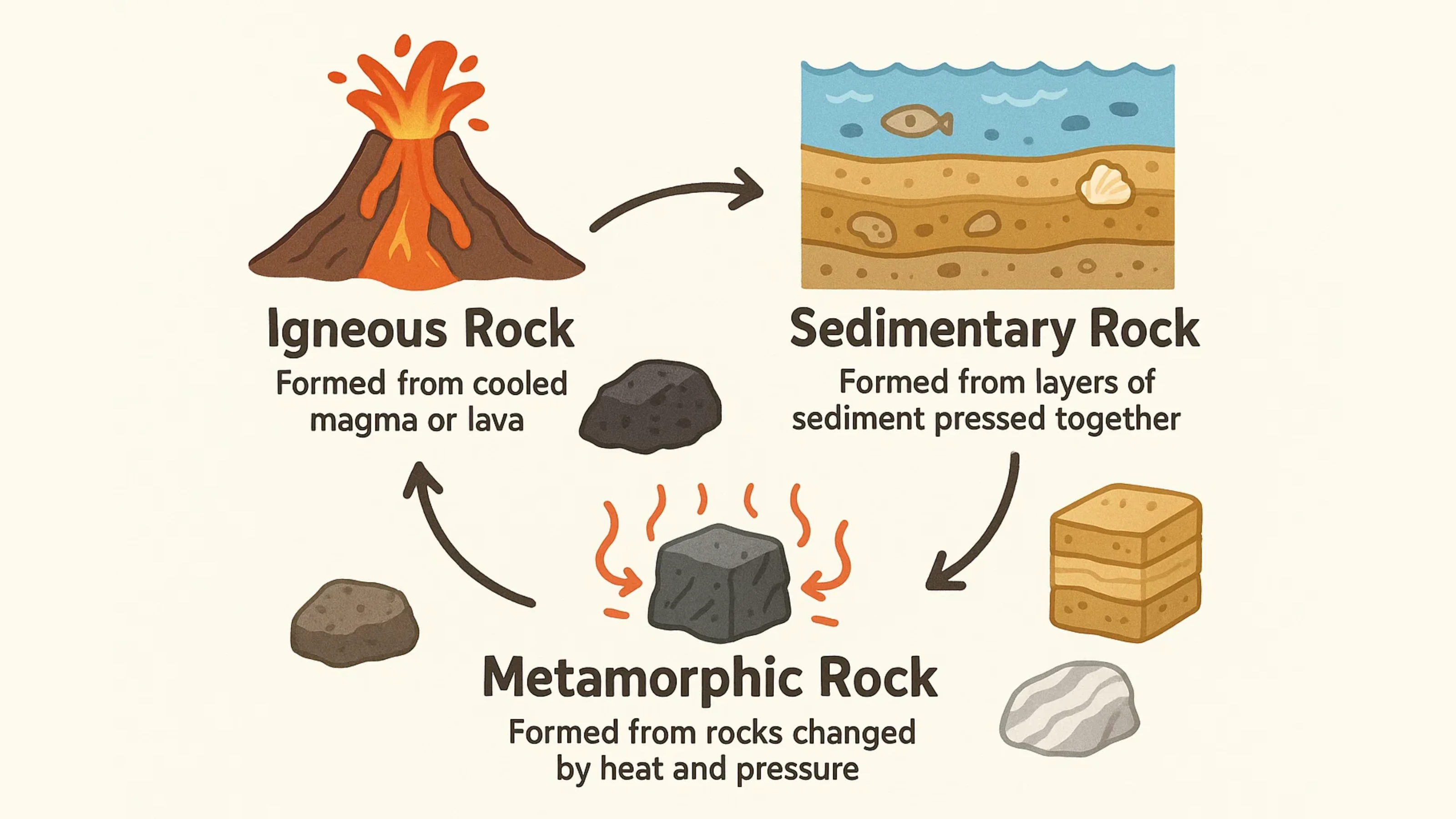
All rocks on Earth fit into three main categories: Igneous rocks form when melted rock (magma or lava) cools and hardens. Sedimentary rocks form when layers of sediment get compressed and cemented together over time. Metamorphic rocks form when existing rocks are changed by heat and pressure.
ROCK TYPES AND EXAMPLES
IGNEOUS ROCKS: Granite (slow cooling), obsidian (fast cooling), pumice (volcanic)
SEDIMENTARY ROCKS: Sandstone (sand), limestone (marine organisms), shale (mud)
METAMORPHIC ROCKS: Marble (from limestone), slate (from shale), quartzite (from sandstone)
FORMATION TIME: Can take thousands to millions of years
RECYCLING: Any rock type can become any other rock type through the rock cycle

Types of Rocks

Types of Rocks Diagram

The Rock Cycle: Nature's Recycling System

The rock cycle shows how rocks continuously change from one type to another through various Earth processes. Weathering and erosion break rocks into sediments. Heat and pressure transform rocks into metamorphic types. Melting and cooling create igneous rocks. It's a never-ending cycle of transformation!

Reading Earth's History in Rocks

Rocks are like pages in Earth's diary! Sedimentary rocks often contain fossils that tell us about ancient life. Rock layers show the order of events in Earth's history. The Grand Canyon is like a giant book where each layer represents millions of years of Earth's story.

ROCK AND MINERAL ACTIVITIES
Start a rock collection and try to identify different types
Look for different minerals in granite using a magnifying glass
Find examples of weathering and erosion in your neighborhood
Create a timeline showing how long different rock formations take

FORCES THAT CHANGE ROCKS
WEATHERING: Wind, water, and ice breaking rocks into smaller pieces
EROSION: Moving weathered rock pieces to new locations
HEAT: High temperatures that can melt or transform rocks
PRESSURE: Weight of overlying rocks that compresses and changes lower rocks
TIME: The main ingredient - rock changes happen very slowly

ROCKS IN OUR DAILY LIVES
CONSTRUCTION: Granite countertops, marble statues, limestone buildings
TECHNOLOGY: Quartz in watches and computers, graphite in pencils
ENERGY: Coal (sedimentary rock) for power, uranium in igneous rocks
SOIL FORMATION: Weathered rocks become the basis for fertile soil
WATER FILTRATION: Rock layers naturally filter groundwater

PROTECTING GEOLOGICAL HERITAGE
CONSERVATION: Protecting unique rock formations and fossil sites
RESPONSIBLE COLLECTING: Take only photos, leave rocks for others to enjoy
GEOLOGICAL PARKS: Special places that preserve Earth's rock history
SUSTAINABLE MINING: Extracting minerals responsibly to minimize environmental impact

The rock cycle teaches us that even the most solid things on Earth are constantly changing - it just happens so slowly that we don't notice it in our human lifetimes!