Have you ever wondered why we have hot summers and cold winters? Or why the sun seems to "rise" and "set" every day? The answers lie in how Earth moves through space! Our planet rotates (spins) and revolves (orbits around the sun) in ways that create the day/night cycle and the changing seasons we experience.
Earth's Daily Spin: Day and Night
Earth rotates on its axis once every 24 hours, which creates our day and night cycle! As Earth spins, different parts of our planet face toward or away from the sun. When your part of Earth faces the sun, you experience daytime. When it faces away from the sun, you experience nighttime.
Earth spins at about 1,000 mph at the equator
One complete rotation takes exactly 23 hours, 56 minutes, and 4 seconds
Earth rotates from west to east (that's why the sun "rises" in the east)
The North and South Poles barely move during rotation
Earth's rotation is gradually slowing down by about 2 milliseconds per century
Earth's Yearly Journey: The Orbit
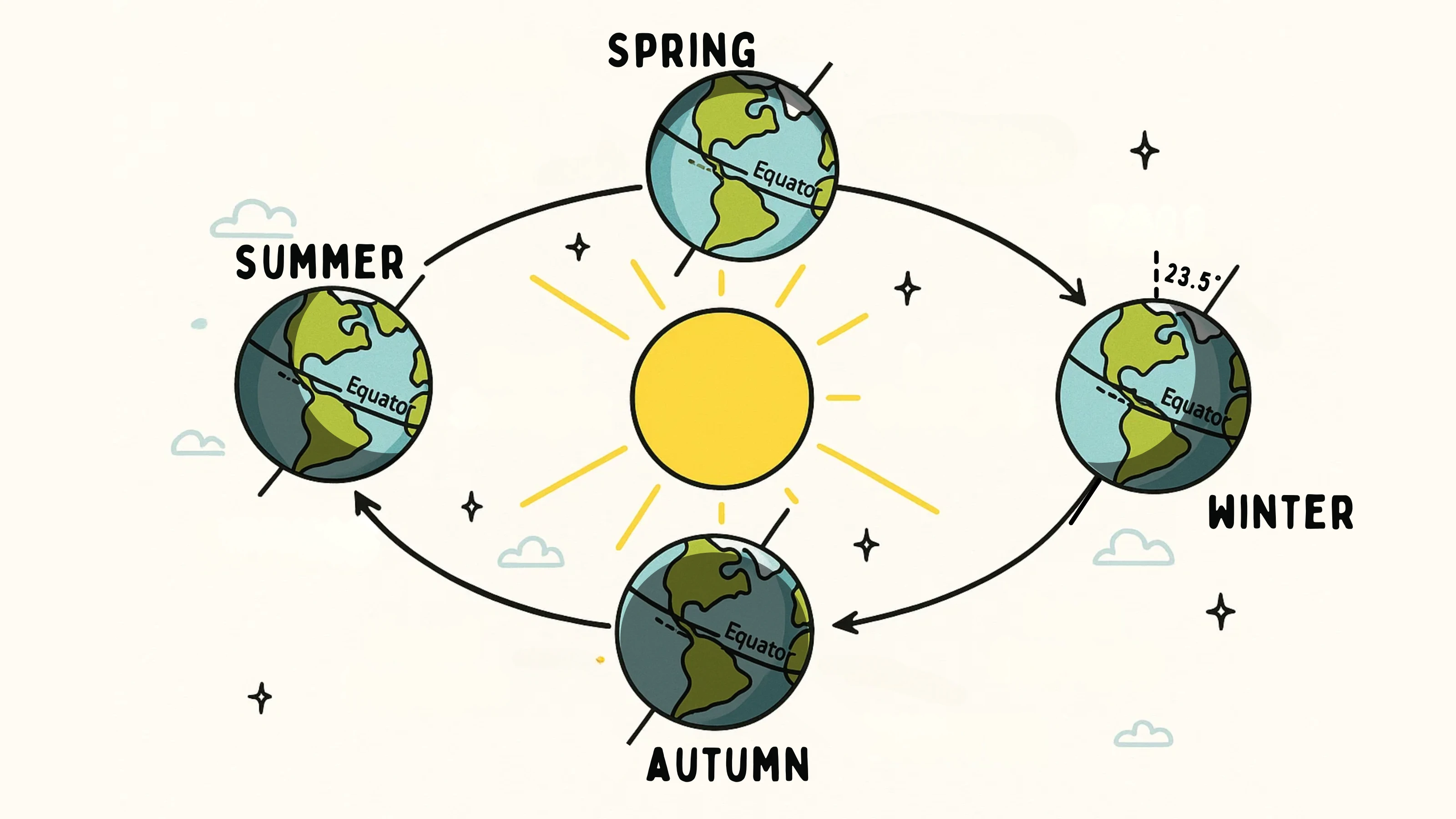
Earth revolves around the sun in an oval-shaped path called an orbit. This journey takes one year (365.25 days) to complete. Earth travels at an incredible speed of about 67,000 mph as it orbits the sun, covering nearly 600 million miles in one year!
Earth's axis is tilted 23.5 degrees compared to its orbit
This tilt means different parts of Earth receive different amounts of sunlight during the year
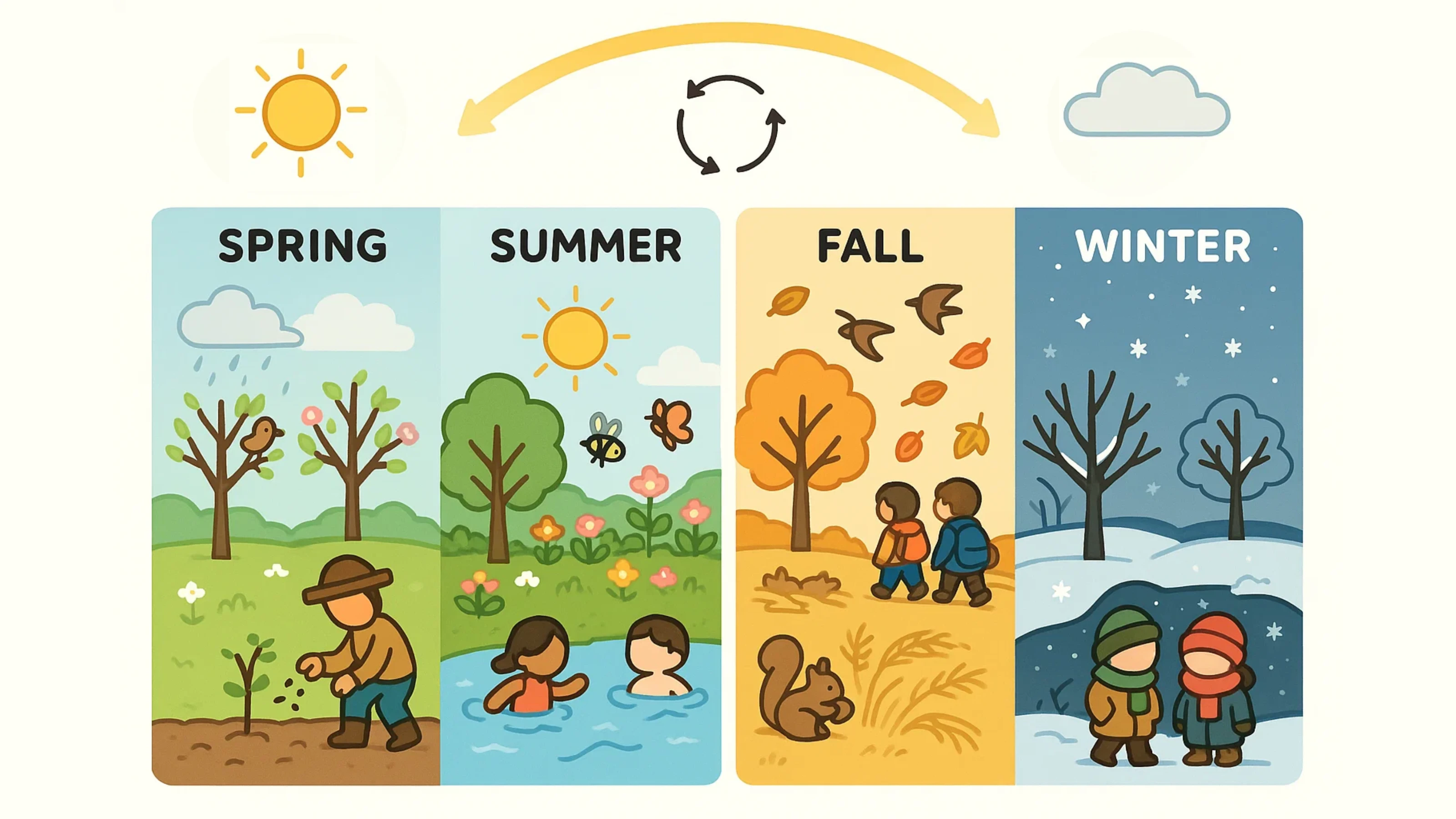
SUMMER:
Your hemisphere tilts toward the sun (more direct sunlight, longer days)
WINTER:
Your hemisphere tilts away from the sun (less direct sunlight, shorter days)
SPRING/FALL:
Neither hemisphere tilts significantly toward or away from the sun
The equator receives fairly consistent sunlight year-round
Why Distance Doesn't Create Seasons
Many people think seasons happen because Earth is closer or farther from the sun, but that's not true! Earth is actually closest to the sun in January (during winter in the Northern Hemisphere). The tilt of Earth's axis is what creates seasons, not the distance from the sun.
Seasonal Changes Around the World
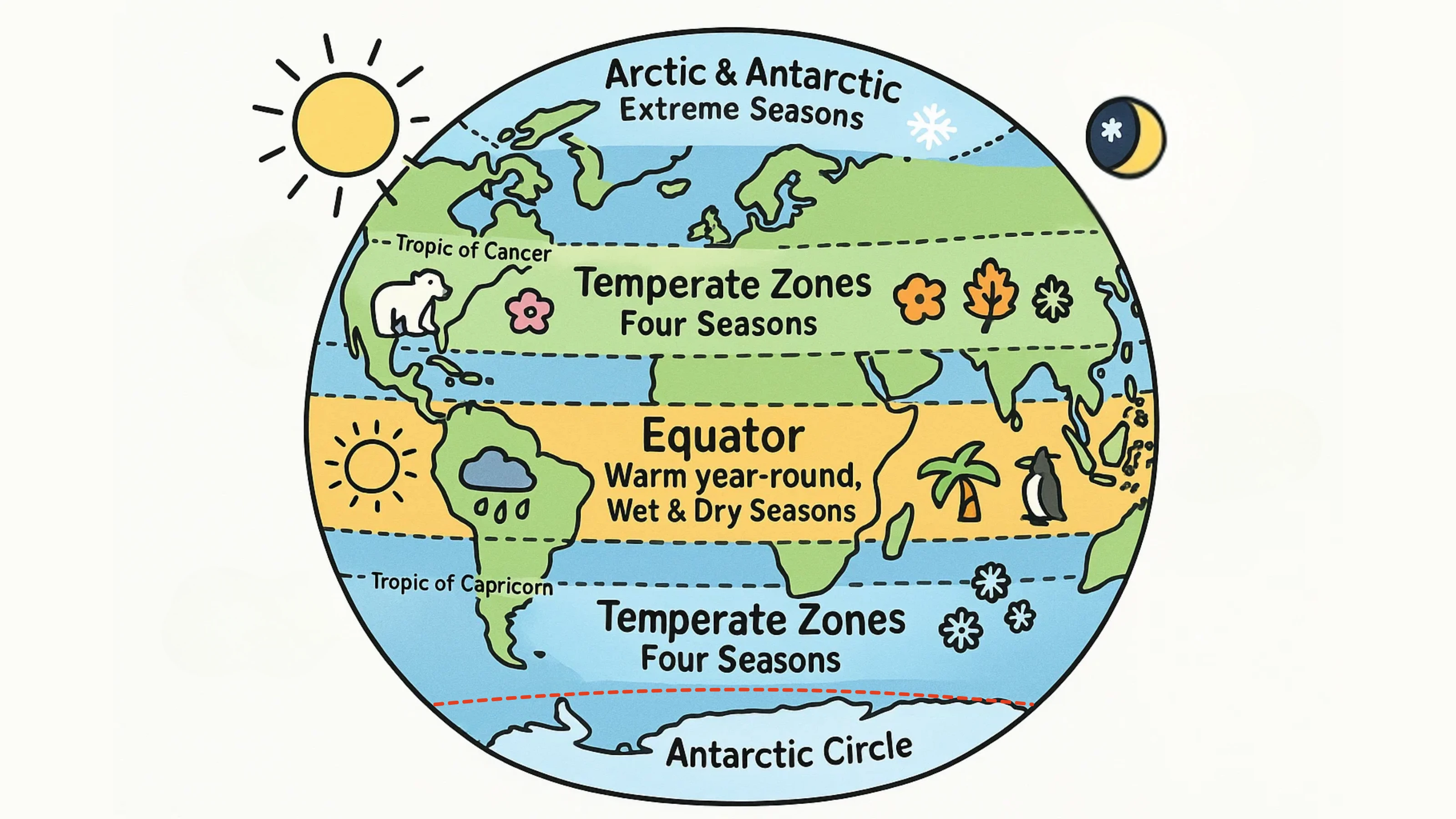
Different parts of Earth experience seasons differently! Places near the equator have warm temperatures year-round with wet and dry seasons. The Arctic and Antarctic regions have extreme seasons with months of continuous daylight or darkness. Temperate regions experience four distinct seasons.
Use a flashlight and globe to demonstrate day/night and seasons
Track sunset and sunrise times throughout the year
Observe how shadows change length during the day and throughout seasons
Chart temperature changes and daylight hours in your area
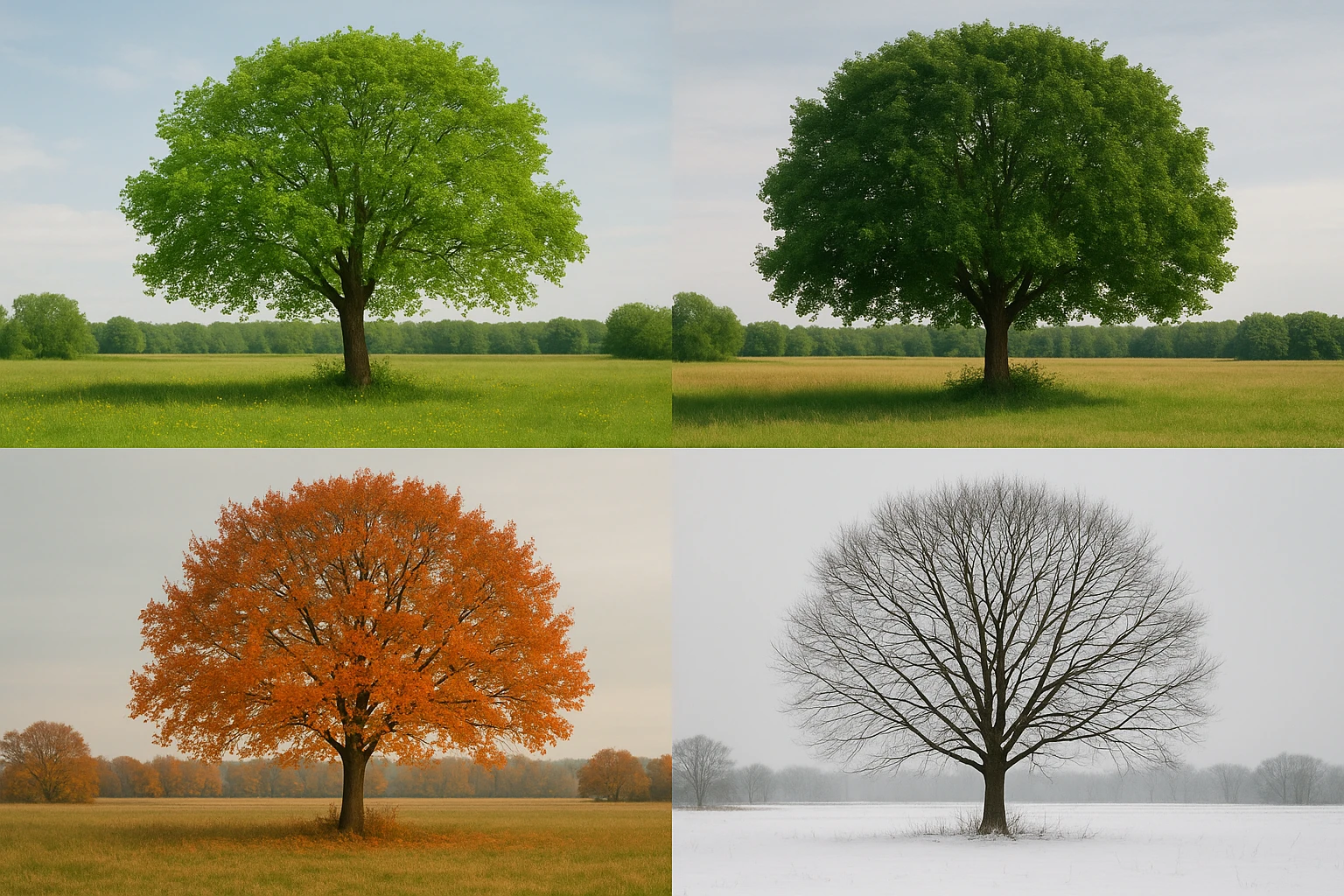
PLANT CYCLES: Trees lose leaves, flowers bloom, crops grow according to seasons
ANIMAL BEHAVIOR: Migration, hibernation, and breeding cycles follow seasonal patterns
WEATHER PATTERNS: Temperature, precipitation, and storm patterns change with seasons
DAYLIGHT HOURS: Summer days are longer, winter days are shorter (except at equator)
HUMAN ACTIVITIES: Agriculture, holidays, and traditions often follow seasonal cycles
SOLSTICES: Longest and shortest days of the year (June 21 and December 21)
EQUINOXES: When day and night are equal length everywhere (March 21 and September 21)
MIDNIGHT SUN: Summer phenomenon in Arctic where sun doesn't set for months
POLAR NIGHT: Winter phenomenon in Arctic where sun doesn't rise for months
SEASONAL LAG: Hottest and coldest temperatures occur after the solstices
STAR PATTERNS: Constellations change position throughout the night and year
MOON PHASES: The moon's appearance changes as Earth, moon, and sun move
PLANET POSITIONS: Other planets appear to move against background stars
SEASONAL STARS: Different constellations are visible in different seasons
TIME ZONES: Earth's rotation creates different times around the world
Understanding Earth's rotation and orbit helps us appreciate that we're passengers on a spinning, orbiting spaceship traveling through the cosmos at incredible speeds!