Inclined Planes
Learn how ramps and wedges help us move heavy objects and understand the science behind inclined planes

Person riding a BMX bike on a bike park ramp
What do a playground slide, a mountain road, and a knife all have in common? They're all examples of inclined planes - simple machines that use sloped surfaces to make work easier! This might seem like the simplest machine of all, but inclined planes are incredibly useful.
What Is an Inclined Plane?
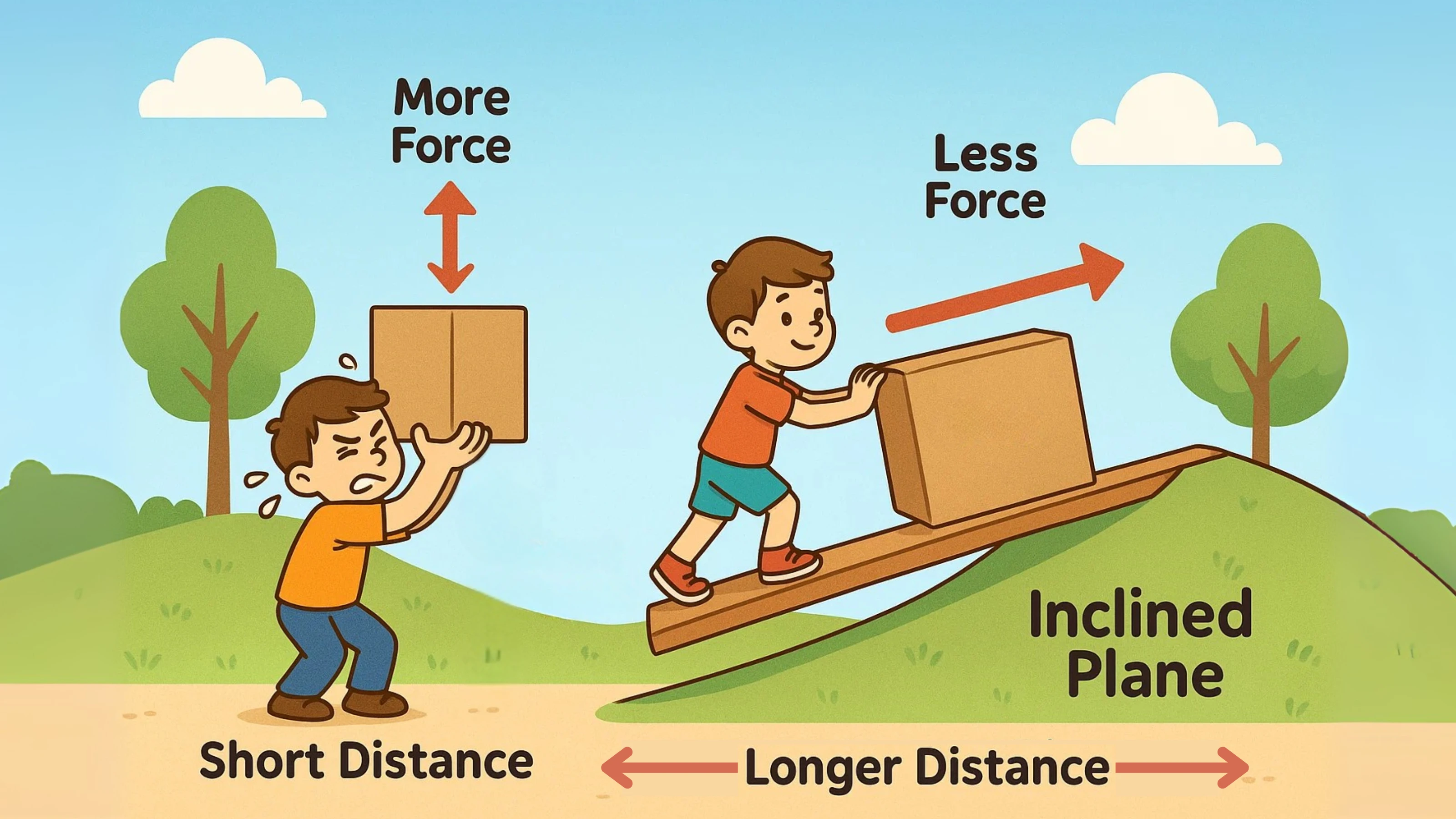
An inclined plane is any sloped surface that helps you move objects from one level to another. Instead of lifting something straight up (which requires a lot of force), you can push or pull it up a gentle slope using less force - but over a longer distance.
Ramps: The Most Common Inclined Plane
Ramps are everywhere! They help people in wheelchairs access buildings, allow trucks to drive onto loading docks, and make it possible to move heavy furniture upstairs. Ancient Egyptians used ramps to move massive stone blocks up the sides of pyramids!

Wedges: Moving Inclined Planes
A wedge is like a moving inclined plane! Instead of moving objects up the ramp, wedges move into objects to split them apart or hold them in place. Axes split wood, knives cut food, and doorstops hold doors open - all using wedge power.
Stairs: Inclined Planes in Steps
Stairs are actually a series of tiny inclined planes! Each step is a small, flat inclined plane that makes climbing to higher floors much easier than trying to climb a steep ramp or ladder. Imagine if every building only had ladders instead of stairs!
The Science Behind the Slope
The angle of an inclined plane determines how much force you need. A very gentle ramp (small angle) requires little force but you have to travel far. A steep ramp (large angle) requires more force but covers less distance. It's always a trade-off between force and distance.
Inclined planes prove that sometimes the smartest solution is also the simplest - why fight gravity when you can work with it instead!