Eris
Discover amazing facts about Eris, the distant dwarf planet whose discovery changed how we classify planets
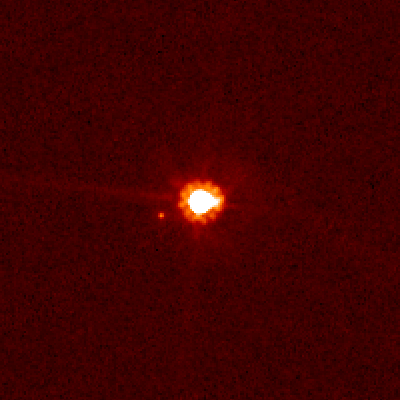
Eris is one of the most distant and reflective objects in our solar system
ILLUSTRATION BY NASA, ESA, and M. Brown (California Institute of Technology)
Eris is known as the "troublemaker" of our solar system because its discovery in 2005 started a big debate about what should be called a planet! When scientists first found Eris, they realized it was about the same size as Pluto but much farther away. This discovery made astronomers ask an important question: if Eris is similar to Pluto, should it also be called the tenth planet? After lots of discussion, scientists decided to create a new category called "dwarf planets" for objects like Eris and Pluto.
Eris lives in a region called the Scattered Disk, which is even farther out than the Kuiper Belt where Pluto lives. This makes Eris one of the most distant objects we know in our solar system! Eris is incredibly cold and covered in a shiny layer of frozen methane that makes it reflect sunlight like a cosmic mirror. It takes Eris 557 Earth years to orbit the Sun just once, and it's currently moving away from the Sun toward the most distant part of its oval-shaped orbit.
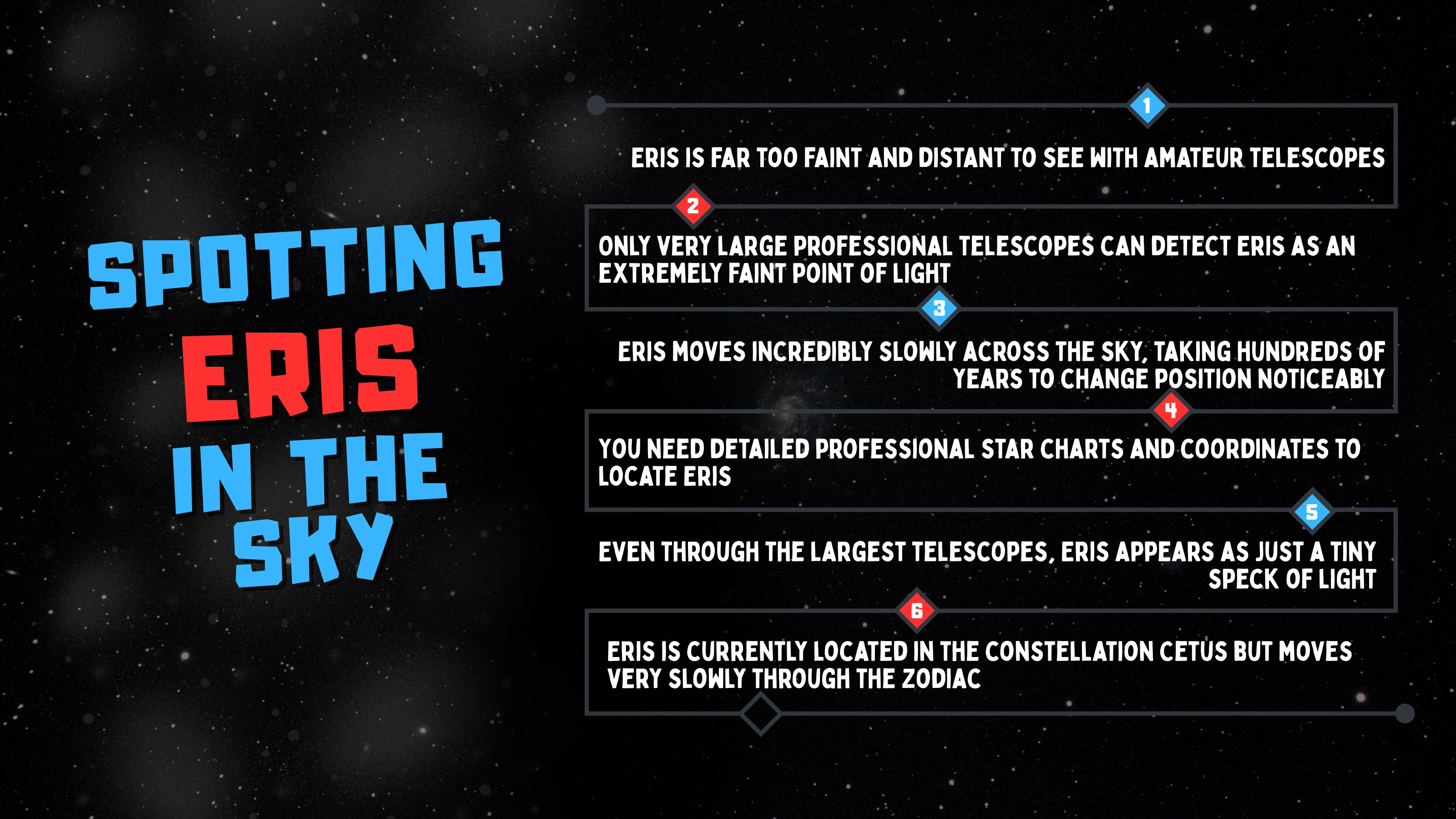
Eris was discovered by astronomer Mike Brown and his team using telescopes in California. The discovery was so important that it earned the nickname "the planet killer" because it led to Pluto being reclassified! Eris is extremely difficult to study because it's so far away that even our most powerful telescopes can barely see it. Most of what we know about Eris comes from carefully watching how it blocks starlight when it passes in front of distant stars.
Currently, no space missions are planned to visit Eris because it would take a spacecraft over 15 years to reach it, and Eris is moving even farther away from the Sun. However, scientists are very interested in learning more about Eris and other distant objects because they can tell us about how our solar system formed billions of years ago. Future telescopes, like the James Webb Space Telescope, might be able to learn more about Eris's composition and whether it has seasons as it travels on its extremely long orbit around the Sun!