Haumea
Discover amazing facts about Haumea, the fast-spinning dwarf planet shaped like a football with its own ring system

Haumea's unusual football shape is caused by its incredibly fast rotation
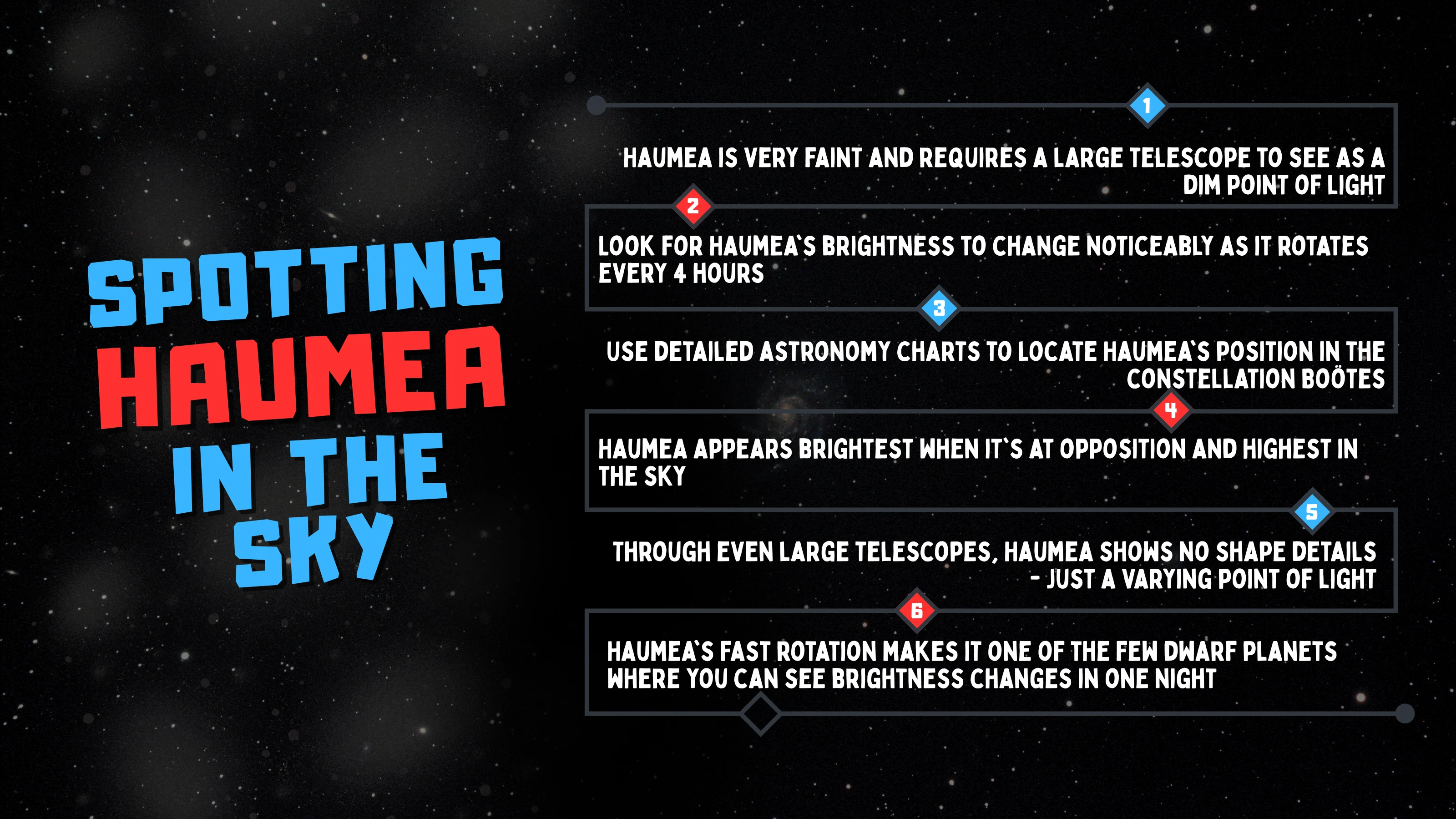
Haumea is definitely the strangest-shaped dwarf planet in our solar system - it looks like a cosmic football! Unlike other planets and dwarf planets that are mostly round, Haumea is stretched out into an oval shape because it spins incredibly fast. Haumea rotates once every 4 hours, making it one of the fastest-spinning large objects in our solar system. This super-fast spinning creates such strong centrifugal force that it stretches Haumea out like a ball of pizza dough being spun in the air!
What makes Haumea even more amazing is that it has its own ring system, just like Saturn! Scientists discovered these rings in 2017 when Haumea passed in front of a distant star, and the star's light was briefly blocked by thin rings around Haumea. This makes Haumea the first dwarf planet known to have rings. Haumea also has two moons named Hi'iaka and Namaka after Hawaiian goddesses, because Haumea itself is named after the Hawaiian goddess of childbirth.
Haumea was discovered in 2004 by two different teams of astronomers - one in Spain and one in California - leading to an interesting controversy about who should get credit for the discovery. The International Astronomical Union eventually gave official naming rights to the Spanish team, who named it after the Hawaiian goddess. Haumea's discovery was made using telescopes that carefully tracked its movement across the sky over many nights.
Because Haumea is so far away and has such an unusual shape, it's very challenging to study. Scientists learn about Haumea by watching how its brightness changes as it rotates, which tells them about its shape and what its surface might be made of. The discovery of Haumea's rings was a complete surprise and shows that there's still so much we don't know about these distant worlds! Future observations might reveal more about how Haumea's rings formed and whether other dwarf planets might also have ring systems we haven't discovered yet!