Red Giant Stars
Discover amazing facts about red giant stars, the enormous aging stars that have grown hundreds of times larger than our Sun

Red giant stars appear orange-red in color and can be hundreds of times larger than our Sun
PHOTOGRAPH BY A. Chiavassa, R. Kudritzki, B. Davies, B. Freytag and S. E. de Mink
Red giant stars are some of the largest and most impressive stars in our galaxy! These enormous stars are what happens when medium-sized stars like our Sun start to run out of fuel in their cores. As they age, they expand to become hundreds of times bigger than they used to be, turning into giant red or orange balls of gas. If our Sun became a red giant, it would be so big that it might swallow up Mercury, Venus, and even Earth!
Red giants are cooler on their surfaces than smaller stars, which is why they appear red or orange instead of white or blue. Even though they're cooler, they're so incredibly huge that they give off much more light than our Sun. Red giants are like the elderly grandparents of the star world - they've lived long lives and have grown quite large, but they're nearing the end of their stellar journey.
Five Famous Red Giants:
Arcturus
The fourth brightest star in our sky, located 37 light-years away in the constellation Boötes. It's about 25 times larger than our Sun!
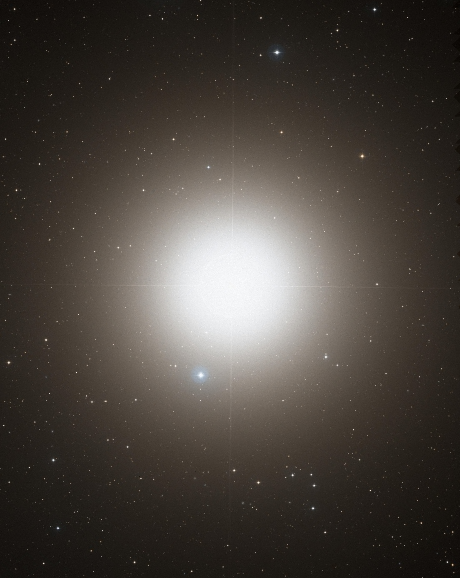 Photo by Mikulski Archive for Space Telescopes (MAST), STScI, and NASA
Aldebaran
The bright orange "eye" of Taurus the Bull, this red giant is 65 light-years away and appears to be part of a star cluster.
 Photo by NASA, ESA, and STScI
Capella
Actually a complex system of four stars, with two red giants orbiting each other, located 43 light-years away in Auriga.
Pollux
The brighter twin in Gemini, this orange giant is 34 light-years away and has its own planet orbiting around it.
Dubhe
One of the bright stars in the Big Dipper, this red giant is 124 light-years away and helps form the famous ladle shape.