Ethiopia

Explore the roof of Africa with ancient history, unique calendar, coffee origins, and the source of the Blue Nile.


Ethiopian landscape showing the dramatic Simien Mountains

Ethiopian landscape showing the dramatic Simien Mountains

Photo BY A. Davey, Wikimedia Commons

Selam! Welcome to the "Roof of Africa," the only African country never to be fully colonized and the birthplace of coffee! Ethiopia is like a land frozen in time, where ancient rock-hewn churches carved from solid stone still hold services after 800 years, where people follow a unique calendar with 13 months, and where the famous Lucy fossil was found - one of our earliest human ancestors who lived 3.2 million years ago. This incredible highland country is also the source of the Blue Nile River and home to some of the most unique animals on Earth found nowhere else.

Ethiopia has been independent for over 2,000 years, making it one of the world's oldest nations, though it was briefly occupied by Italy from 1936-1941. The name "Ethiopia" comes from the ancient Greek "Aithiopia," meaning "land of burnt faces," referring to the dark-skinned people. Ethiopians call their country "Ityop'iya" in Amharic, their main language. Ethiopia follows its own ancient calendar with 13 months and celebrates New Year in September, making it 7-8 years behind the Gregorian calendar!

Map of Ethiopia

Map of Ethiopia showing its regions, highlands including Simien Mountains, source of Blue Nile, Danakil Depression, and landlocked position in the Horn of Africa. Image Credit: NordNordWest, Wikimedia Commons

Ethiopian FlagEucalyptus TreeThick-Billed RavenEthiopian Birr
Ethiopian national symbols: green, yellow, and red flag with blue disc and star, eucalyptus tree, thick-billed raven, and Ethiopian birr. Image Credits (from top left to bottom right): User:SKopp, Wikimedia Commons; Johnson waithaka, Wikimedia Commons; Ondřej Žváček, Wikimedia Commons; Mbele2025, Wikimedia Commons

ETHIOPIA FACTS
ANCIENT INDEPENDENCE: Over 2,000 years (never fully colonized)
POPULATION: About 123.4 million people (2nd most populous in Africa)
CAPITAL: Addis Ababa
REGIONS: 12 regions
BIGGEST CITY: Addis Ababa (5.2 million people)
NATIONAL BIRD: Thick-billed Raven (unofficial)
NATIONAL FLOWER: Calla Lily (unofficial)

History and Geography
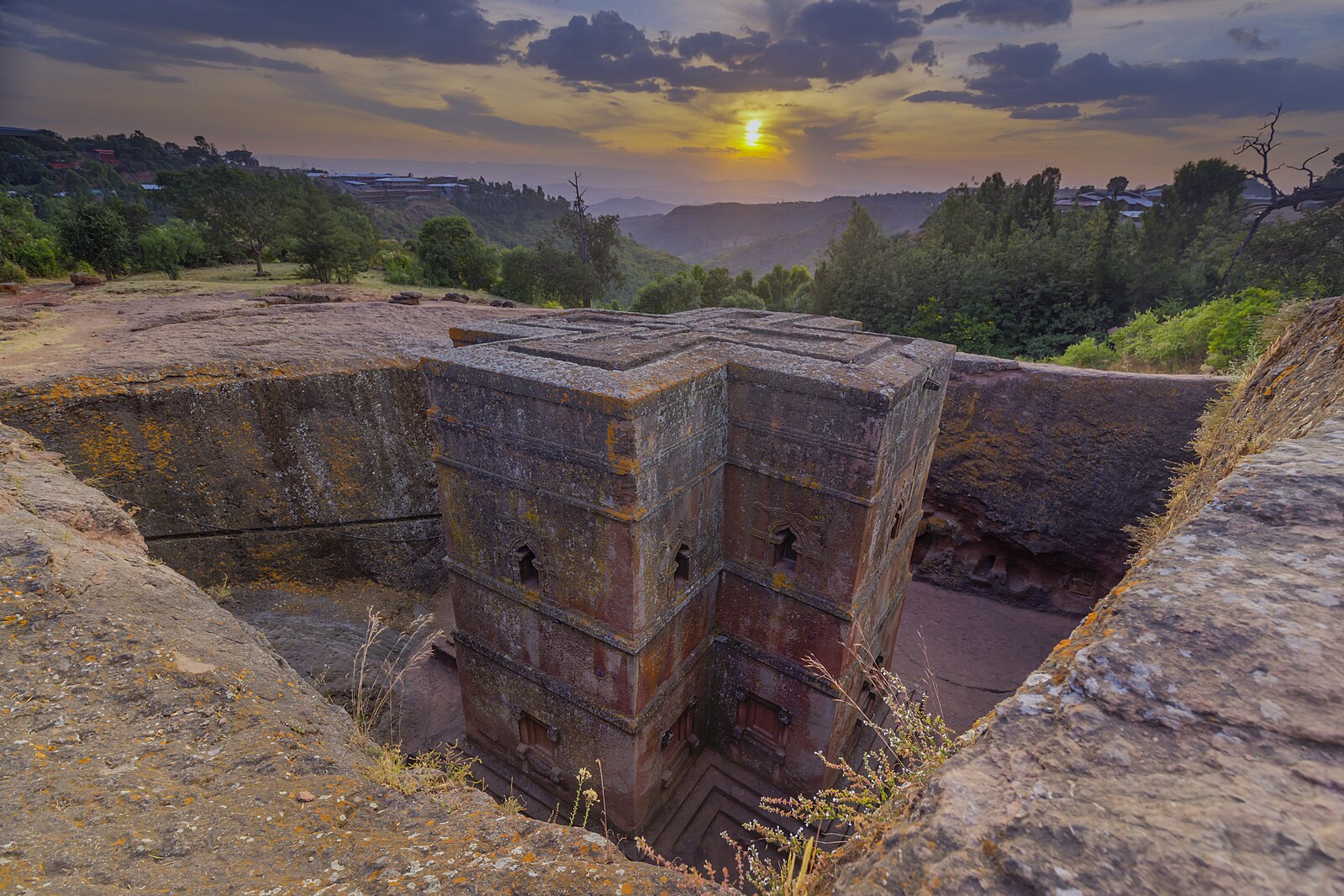
Ethiopia is called the "Roof of Africa" because much of the country sits over 8,000 feet above sea level on the Ethiopian Highlands! The country is home to incredible ancient sites like Lalibela, where 11 churches were carved directly into solid rock in the 12th century and still hold religious services today. Ethiopia is also the source of the Blue Nile River, which begins at Lake Tana and flows north to meet the White Nile in Sudan, forming the mighty Nile River that flows through Egypt to the Mediterranean Sea.

Churches of LalibelaSimien MountainsBlue Nile FallsDanakil Depression Salt Flats
Ethiopia's dramatic geography: ancient rock-hewn churches of Lalibela carved from stone, dramatic Simien Mountains with deep valleys, Blue Nile Falls thundering into gorges, and otherworldly Danakil Depression salt flats. Image Credits (from top left to bottom right): Thomas Fuhrmann, Wikimedia Commons; Hulivili, Wikimedia Commons; A.Savin, Wikimedia Commons; A.Savin, Wikimedia Commons

Amazing Wildlife

The intelligent thick-billed raven is found only in Ethiopia and is one of the world's highest-altitude birds, living in the mountains up to 14,000 feet! Ethiopia has many endemic species found nowhere else on Earth, including the endangered Ethiopian wolf (the world's rarest canid), gelada monkeys that live only in Ethiopian highlands and are the last grass-eating primates, and the Walia ibex, a wild goat that lives on cliff faces in the Simien Mountains.

Thick-Billed RavensEthiopian WolvesGelada MonkeysWalia Ibex
Ethiopia's unique animals: thick-billed ravens soaring over mountain peaks, endangered Ethiopian wolves in highland meadows, gelada monkeys with distinctive red chests, and Walia ibex climbing steep mountain cliffs. Image Credits (from top left to bottom right): stephen, Wikimedia Commons; Charles J. Sharp, Wikimedia Commons; A. Davey, Wikimedia Commons; Leonard A. Floyd, Wikimedia Commons

Natural Resources

Ethiopia is the birthplace of coffee! According to legend, a goat herder named Kaldi discovered coffee when his goats became energetic after eating certain berries around 850 CE. Today, Ethiopia produces some of the world's finest coffee beans with unique flavors. The country also has gold deposits, hydroelectric power from its many rivers and highlands, and fertile volcanic soil perfect for growing various crops. Ethiopia's ancient history and unique culture attract tourists interested in archaeology and cultural heritage.

Coffee PlantationsHydroelectric Dams
Ethiopia's treasures: traditional coffee plantations where coffee originated and hydroelectric dams using highland rivers to generate clean energy. Image Credits (from left to right): Niels Van Iperen, Wikimedia Commons; Mimi Abebayehu, Wikimedia Commons

ANCIENT ETHIOPIA FACTS
Ethiopia follows its own calendar with 13 months and celebrates New Year in September making it 7-8 years behind our calendar
The country was never fully colonized making it one of only two African nations (with Liberia) to maintain independence
Ethiopia is home to Lucy, one of the most famous early human fossils discovered, dating back 3.2 million years
The ancient kingdom of Aksum in Ethiopia was one of the four great powers of the ancient world along with Rome, Persia, and China

Ethiopia truly is Africa's ancient kingdom, where coffee was born, where time moves to its own rhythm, and where highlands touch the sky while preserving some of humanity's oldest traditions and our earliest ancestors' footsteps!